Stationary Bike vs Smart Trainer vs Rollers vs Ultiracer: 5 Ways to Cycle Indoors This Winter, Compared
By Shaun Cheon
The days are getting shorter, the mornings colder, and sooner or later every rider asks the same question: how do I keep cycling indoors without losing what I love about cycling? The answer depends on what you think cycling actually is. If it is just pedalling, any exercise bike will do. But if you have ever carved a fast corner or felt a bike settle under you on a descent, you know that the heart of cycling is movement: steering, balancing and coordinating your whole body with a machine that leans. Keep that in mind, because it is the thread that runs through every option below.
In this guide we compare the five main ways to ride indoors - the fixed stationary bike, the wheel-on smart trainer, the direct-drive smart trainer, free rollers and Ultiracer - and look at how each one works, what it does well, where it falls short, how effective it is as exercise and what it offers for virtual cycling and steering. By the end you should know exactly which one belongs in your living room this winter.
First, what cycling really trains
Cycling is one of the best-evidenced forms of exercise there is. A systematic review of the health effects of cycling found consistent benefits for cardiovascular fitness, weight management and all-cause mortality (Oja et al., 2011), and a five-year study of 264,337 people in the UK Biobank found that commuting by bicycle was associated with a 41% lower risk of premature death and a 46% lower risk of heart disease compared with sedentary commuting (University of Glasgow / BMJ, 2017).
But those studies were about riding real bicycles outdoors, and a real bicycle asks far more of you than a pair of legs. To stay upright at all, your inner ear, eyes, joints and muscles have to agree dozens of times a second on which way is up. Every bend is a small lesson in steering, every bump a small test of balance, and the whole thing is held together by coordination between your upper body, your core and your pedal stroke. That is why cycling is as much a skill as a workout, and it is why researchers are increasingly interested in cycling and the brain: an eight-week study by the University of Reading and Oxford Brookes University found that adults aged 50 to 83 who cycled regularly improved on measures of executive function and processing speed (PLOS One, 2019). Balance, in turn, is the single most trainable protection against falls in later life: a Cochrane review of 108 trials found that exercise reduces the rate of falls in older people by around 23%, with the strongest effect from programmes that challenge balance (Cochrane, 2019).
So the real question for any indoor setup is not only "how hard can I pedal?" but "how much of the movement survives?" Let's find out.
1. The fixed stationary bike (spin bike, upright or recumbent)
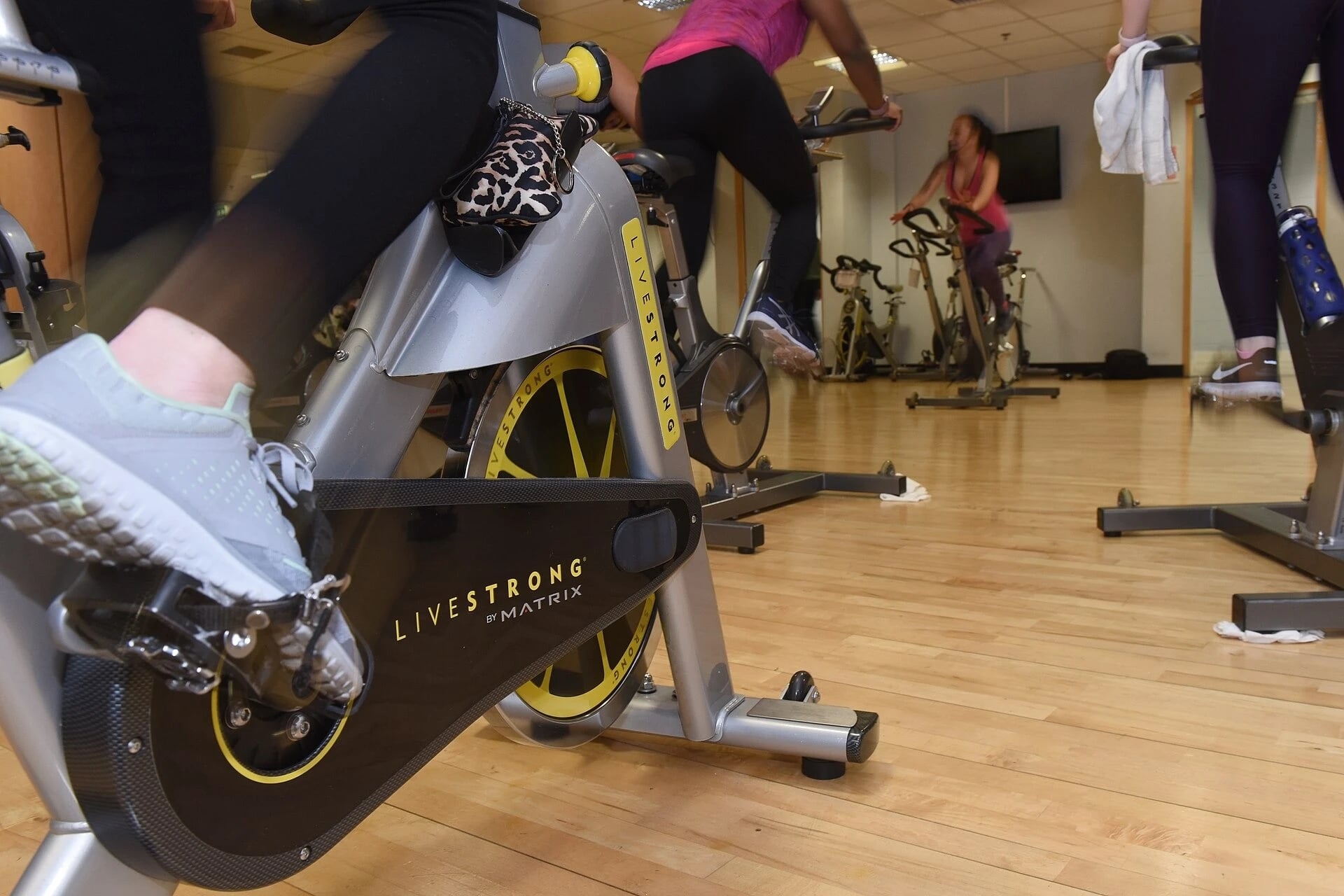
How it works. A stationary bike is a self-contained machine: a saddle, handlebars and cranks bolted to a heavy frame, with a weighted flywheel and a friction, magnetic or electromagnetic brake to provide resistance. Nothing moves except the pedals. Spin bikes use a heavy fixed-gear flywheel for a road-like feel; upright and recumbent bikes trade that feel for comfort and back support.
What is good. It is the simplest and most accessible way to ride indoors. There is no bike to mount, no tyre to wear out and no skill required, which is why every gym has a row of them and why group classes are so popular. It is safe for complete beginners and for people with limited mobility, and connected models can stream classes or virtual rides to a screen.
What is not. The frame is rigid, so the bike never leans, never steers and never asks you to balance. The geometry rarely matches your own bicycle, so the position can feel foreign to real cyclists, and the ride itself is one-dimensional: many people simply find it boring, which is the quiet killer of any winter fitness plan.
How effective is it as exercise? Excellent for cardiovascular fitness and leg strength, and as good as any machine for burning calories. For balance, coordination and bike-handling skill, close to zero.
Virtual cycling and steering. Connected stationary bikes can show virtual worlds, but the bike itself cannot steer. Where apps allow it, your avatar auto-steers or you tap a button on the handlebars or a controller. Your body never turns.
2. The wheel-on smart trainer
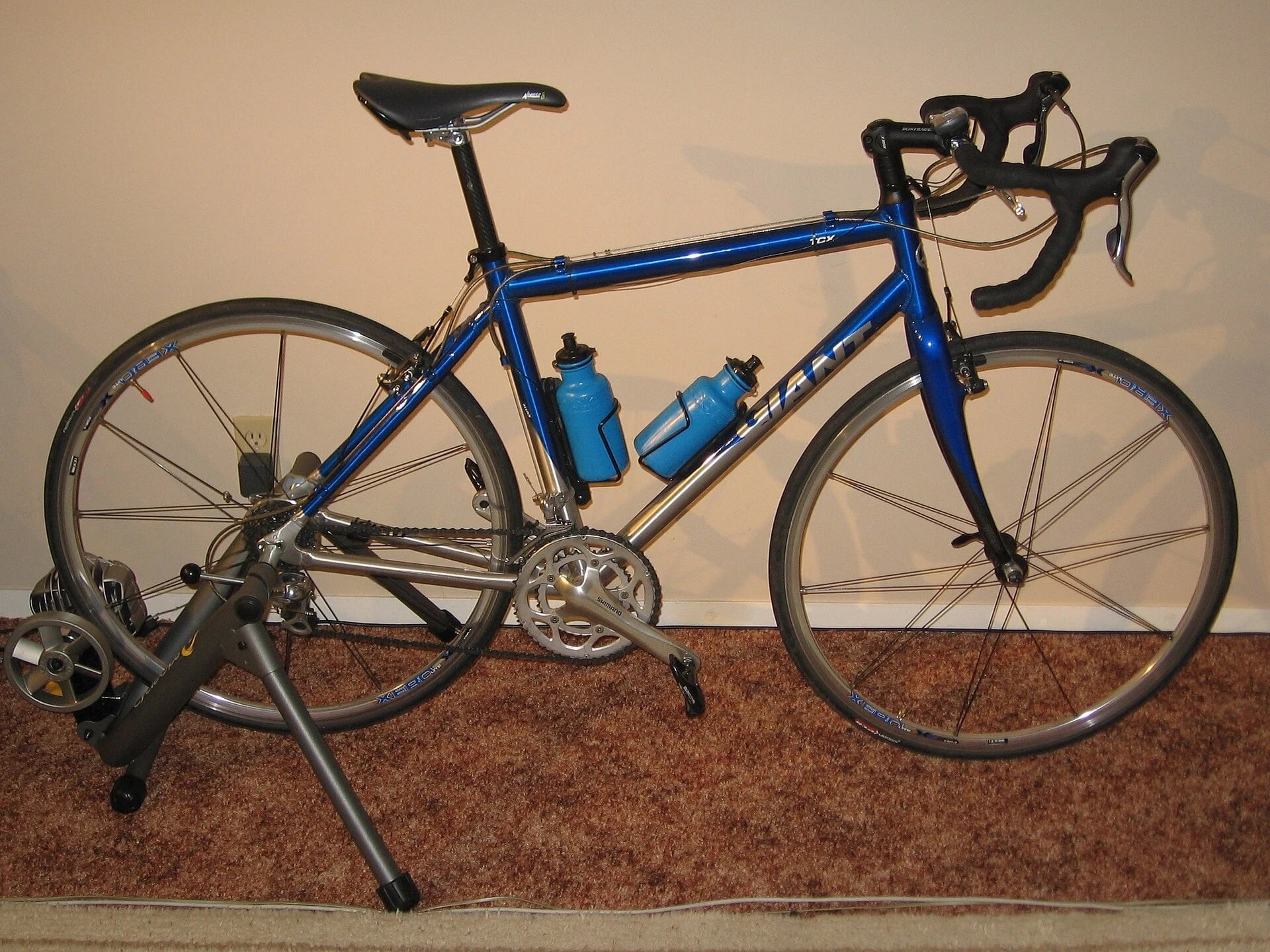
How it works. A wheel-on trainer (also called a tyre-drive or turbo trainer) clamps your bicycle's rear axle in an A-frame and presses the rear tyre against a small resistance roller driven by a fluid, magnetic or electromagnetic unit. "Smart" versions measure your power and let an app such as Zwift control the resistance to simulate hills.
What is good. You ride your own bike, with your own saddle and fit, for a modest price - popular smart models sit in the US$300 to US$500 range (Zwift Insider's trainer guide). It folds flat, sets up in minutes and gets you into virtual worlds with structured workouts.
What is not. The tyre-on-roller design has real costs: tyre wear, noise, and the need to recalibrate whenever tyre pressure or temperature changes. Power accuracy is typically around plus or minus 5%, and maximum resistance is lower than direct-drive units. Most of all, the bike is locked rigidly upright. Riders often add a rocking plate underneath just to get a few degrees of sway back, which tells you how unnatural a fixed bike feels after an hour.
How effective is it as exercise? Very good for aerobic fitness and structured power training. Nothing for balance or coordination, and the fixed frame can make long sessions hard on the saddle and lower back.
Virtual cycling and steering. Full virtual-world support. Steering requires an add-on: a steering plate under the front wheel such as the Elite Sterzo Smart, which detects handlebar turns, or handlebar-mounted button controllers such as Zwift Play (Zwift on steering). Either way you turn a wheel or press a button while the bike itself stays still.
3. The direct-drive smart trainer
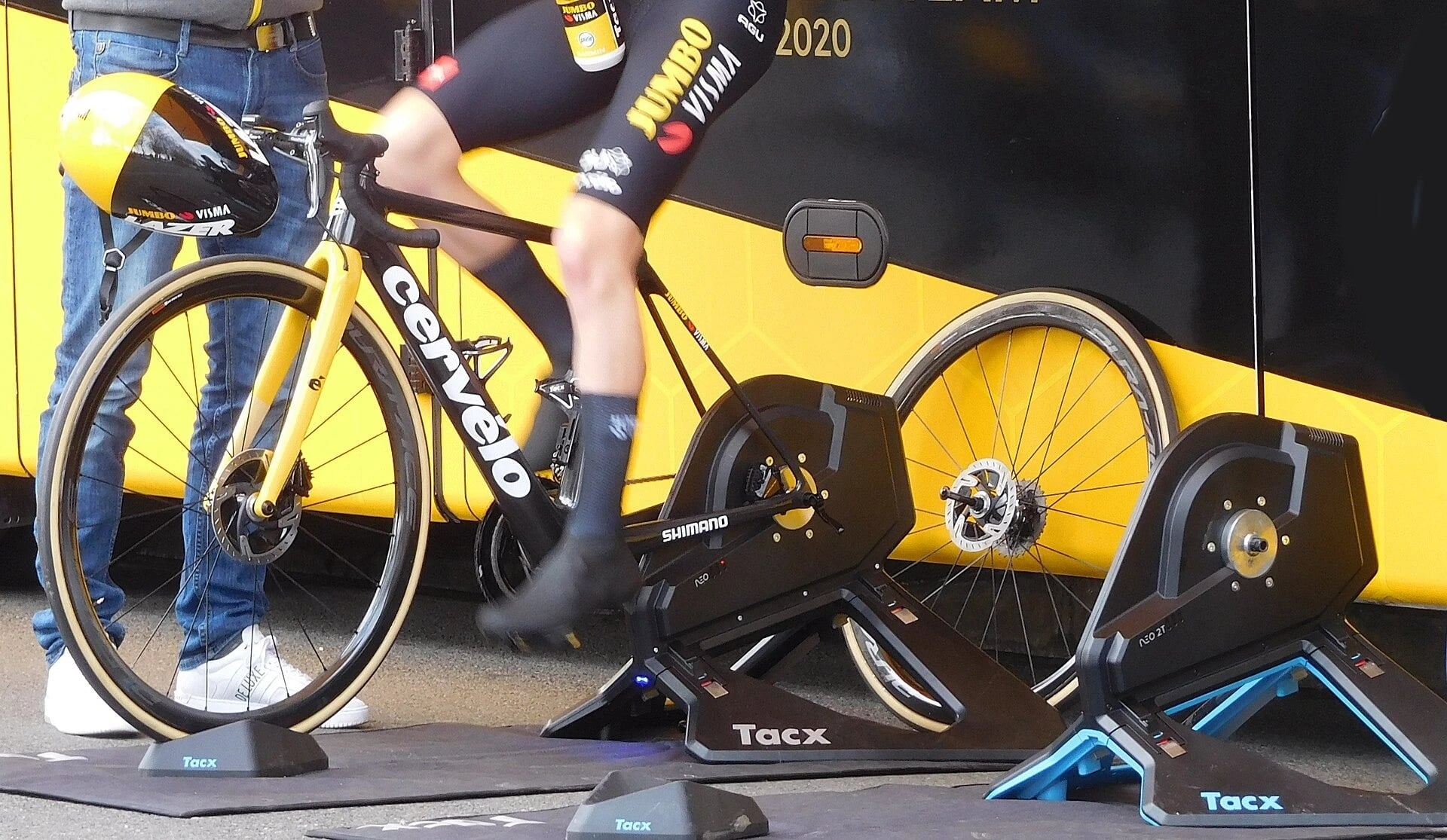
How it works. You remove the rear wheel entirely and mount the bike's dropouts directly onto the trainer, which carries its own cassette. Your chain drives the trainer's flywheel and electromagnetic resistance unit, so there is no tyre contact at all.
What is good. This is the gold standard for serious indoor training: power accuracy around plus or minus 2%, quiet operation, high maximum resistance and gradient simulation, and little or no calibration (Zwift Insider). ERG mode holds a target wattage for you, which is why coaches and pro teams use direct-drive units for warm-ups, intervals and virtual racing.
What is not. It is expensive - budget units start around US$750 and premium models run past US$950 - and it is heavy. Swapping bikes means swapping cassettes. And it shares the fundamental limitation of every trainer: the bike is bolted upright. Accessories such as climb simulators tilt the front end up and down, and rocking plates add a little sway, but nothing lets you lean into a corner.
How effective is it as exercise? The best tool on this list for measured, repeatable power training and aerobic conditioning. Still zero contribution to balance or coordination.
Virtual cycling and steering. The best-supported category for virtual platforms. Steering comes from the same add-ons as above (a steering plate or button controllers), or from integrated smart bikes whose handlebars pivot to send steering input. In all cases the input is a hand movement or a button press; your body does not move with the bike.
4. Free rollers

How it works. Rollers are the oldest indoor cycling device of all: three drums in a frame, with a belt linking the front drum to the rear pair so the front wheel spins. Nothing holds the bike. You ride on top of the drums exactly as you would on the road, and your balance and steering keep you there.
What is good. Rollers are the closest thing to real riding you can do indoors, which is why professional riders have used them for a century to warm up before races and to polish their pedalling. They force a smooth, round pedal stroke, a quiet upper body and constant micro-corrections of balance and steering. Everything we said about movement at the top of this article is alive and well on rollers.
What is not. They are dangerous. Lose concentration, reach for a water bottle or look at your phone and you can ride straight off the side, which is why most people learn in a doorway with a hand on the frame. They take weeks to master, offer little resistance for hard intervals unless you buy a resistance or smart model, and are simply not an option for beginners, children or older adults.
How effective is it as exercise? Superb for skill, balance, coordination and cadence. Moderate for raw power unless you add resistance. Nerve-racking for anyone who is not already an experienced cyclist.
Virtual cycling and steering. Some smart rollers transmit power and speed to virtual platforms, but steering is effectively unsupported: your real handlebar movements are keeping you on the drums, not moving an avatar, and looking away from the front wheel to watch a screen is exactly how people fall off.
5. Ultiracer: all the movement of rollers, none of the risk
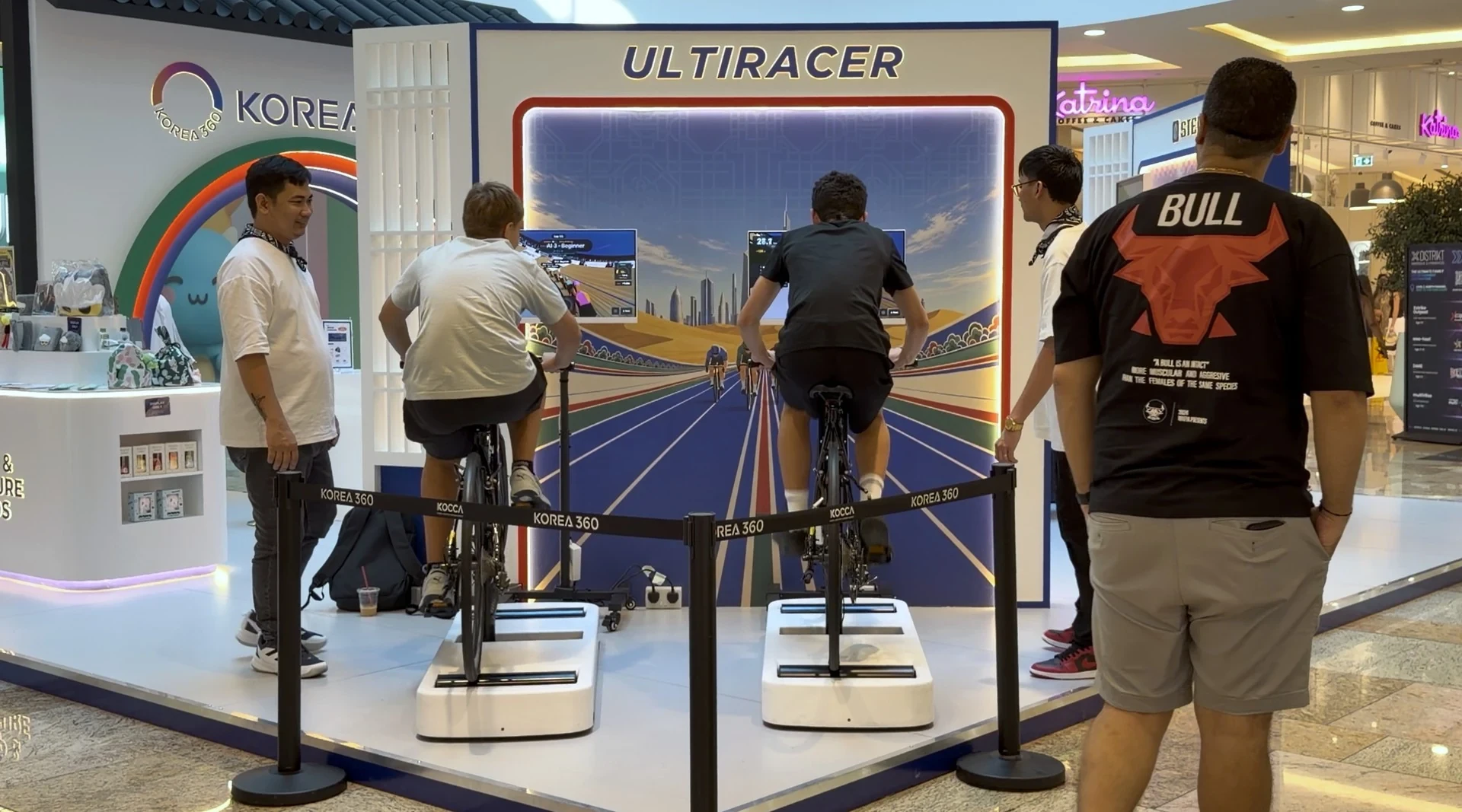
How it works. Ultiracer takes a different approach from every device above. A real bicycle sits on a motion platform that allows it to lean, sway and steer, just as it would on rollers, while the platform itself keeps the bike from ever falling over. Sensors read how the bicycle moves throughout the ride, and our proprietary motion analysis turns those movements into live readouts of balance quality, sway and coordination on the screen in front of you. The rider simply pedals and rides; the system does the measuring.
What is good. This is the "best of all worlds" we have been building towards. You get the free, natural movement that makes rollers the pros' choice - steering, balancing and coordinating your whole body - with none of the roller's danger. In fact it is so safe that complete first-time riders use it every day: at community events and senior centres in Korea we regularly see riders from children in their early teens to adults in their eighties take a turn, and at the Bangbae-gol 1080 Festival more than four in ten riders were 70 or older. For enthusiasts there is a bonus that no trainer can match: because the bike actually steers, you steer through virtual courses by moving your body left and right, not by pressing a button. And because the system reads balance and coordination on every ride, it doubles as a fall-prevention and brain-health tool - what we call Neurocycling - which is why senior welfare centres install it in their fitness rooms.
What is not. Ultiracer is not for everyone, and we are happy to say so. It is not for people who want to lean back and let their legs pedal away while the rest of the body switches off. It is not for people who do not want to make the most of every minute of their exercise time. And it is not for people who are content with half of what cycling offers - the legs and lungs - and would rather leave the balance, coordination and cognitive benefits on the table. Floor space, for the record, is not a reason to hesitate: the whole unit occupies about the same footprint as a set of rollers, and every option on this list takes up essentially the same patch of floor.
How effective is it as exercise? A full cardiovascular and leg workout, plus the balance, steering and coordination training that every fixed trainer leaves out. Want power data too? Because Ultiracer rides on a real bicycle, you simply bring your own power meter - crank, pedal or hub, specced to whatever accuracy you like. Our research page collects the studies on cycling, balance and cognitive health that guide our work, including the growing evidence on cycling and the ageing brain.
Virtual cycling and steering. Built in from the start. Riding courses run on the screen, and left-right steering comes from the rider's own lean and body movement - the only option on this list where virtual steering is a whole-body skill rather than a hand or thumb input.
The comparison at a glance
| Stationary bike | Wheel-on trainer | Direct-drive trainer | Rollers | Ultiracer | |
|---|---|---|---|---|---|
| Ride your own bike | No | Yes | Yes | Yes | Real bike included |
| Bike leans and steers | No | No | No | Yes | Yes |
| Trains balance and coordination | No | No | No | Yes | Yes, and measures it |
| Safe for first-time riders | Yes | Yes | Yes | No | Yes, from teens to 80s |
| Power accuracy / ERG mode | Varies | About 5% | About 2%, ERG | Limited | Bring your own power meter, specced to your liking |
| Virtual steering input | Button or auto | Plate or buttons | Plate, buttons or smart bike | None in practice | Body lean, left and right |
| Noise and tyre wear | Low | High | Low | Moderate | Low |
So which one should you ride this winter?
If you want the cheapest safe way to spin your legs, a stationary bike or a wheel-on trainer will get you through until spring. If you are chasing watts and race results, a direct-drive trainer is the precision instrument, and nothing here replaces it for ERG intervals. If you want to ride like a pro and you already have the skill, rollers will make you a better cyclist - as long as you never look away.
But if you believe, as we do, that cycling is about movement - steering, balancing and coordinating body and machine - and you want that movement indoors without the risk, with real body-steering in virtual courses and with balance feedback that tells you how you are doing, then Ultiracer is the one that does it all. From the teenager trying a bike for the first time to a grandmother in her eighties riding beside her grandchildren, it is the indoor ride that keeps the best part of cycling alive.
Curious to try it, or interested in bringing Ultiracer to your gym, senior centre, rehabilitation clinic or community space? Get in touch through our contact page - we would be glad to arrange a demo.