Neurocycling for Fall Prevention: Ultiracer at the Bangbae-gol 1080 Festival, Seoul
By Platform Admin
On a bright Wednesday morning in September, a single Ultiracer Kiosk stood on the pavement outside Bangbae Senior Welfare Center in Seocho-gu, Seoul, under a banner that read "Zero falls! Fall-prevention experience". By lunchtime, residents from a child under 14 to neighbours in their seventies and early eighties had taken a turn on the saddle, and each of them had watched their own balance being analysed live on the screen in front of them. This is what we mean by Neurocycling: a bicycle ride that works the brain's balance and coordination systems as much as the legs - and it was the reason RealDesignTech was invited to the 9th Bangbae-gol 1080 Festival on 16 September 2026.
The invitation was not a one-off. The welfare center already runs four Ultiracer units in its fitness room, so for many of the older riders the festival was a first taste of equipment they can keep using all year round.
What the Dalak Bangbae Bazaar and the 1080 Festival are
The Dalak (多樂) Bangbae Bazaar & Bangbae-gol 1080 Da-eoullim Festival is a community welfare event organised by Seocho-gu's Bangbae Senior Welfare Center, a public senior center at 48 Bangbaecheon-ro that provides health promotion, meals, counselling, day care and later-life education for the neighbourhood's older residents. The bazaar raises funds for the center's senior welfare programmes, and the festival - now in its ninth year - brings the whole neighbourhood together for a day. The 2026 edition ran under the theme "Our neighbourhood, drawn together across generations" (세대가 함께 그리는 우리마을), with balloon art, eco-friendly tumbler-bag crafts, a mental-wellbeing check-in and, listed by the organisers as the "Ultiracer fall-prevention experience", our kiosk (Bangbae Senior Welfare Center).
Unlike a trade show, nobody here was shopping for equipment. People came for their neighbours, their grandchildren and a good morning out. That made it the right place to answer a simple question: will older adults enjoy getting on a bicycle that measures their balance, and will they want to come back?
One kiosk, riders from their teens to their eighties
Ultiracer Kiosk is the self-service version of Ultiracer: a real bicycle mounted on a platform that lets it lean and steer, a screen that runs our riding courses, and sensors that read balance and coordination throughout the ride. We set it up beside the center's own booth, and from half past nine the queue formed almost entirely of older adults. Riding peaked around eleven o'clock, and by the time the last rider stepped off shortly after noon, six in ten riders had been aged 60 or over, and more than four in ten were 70 or older.
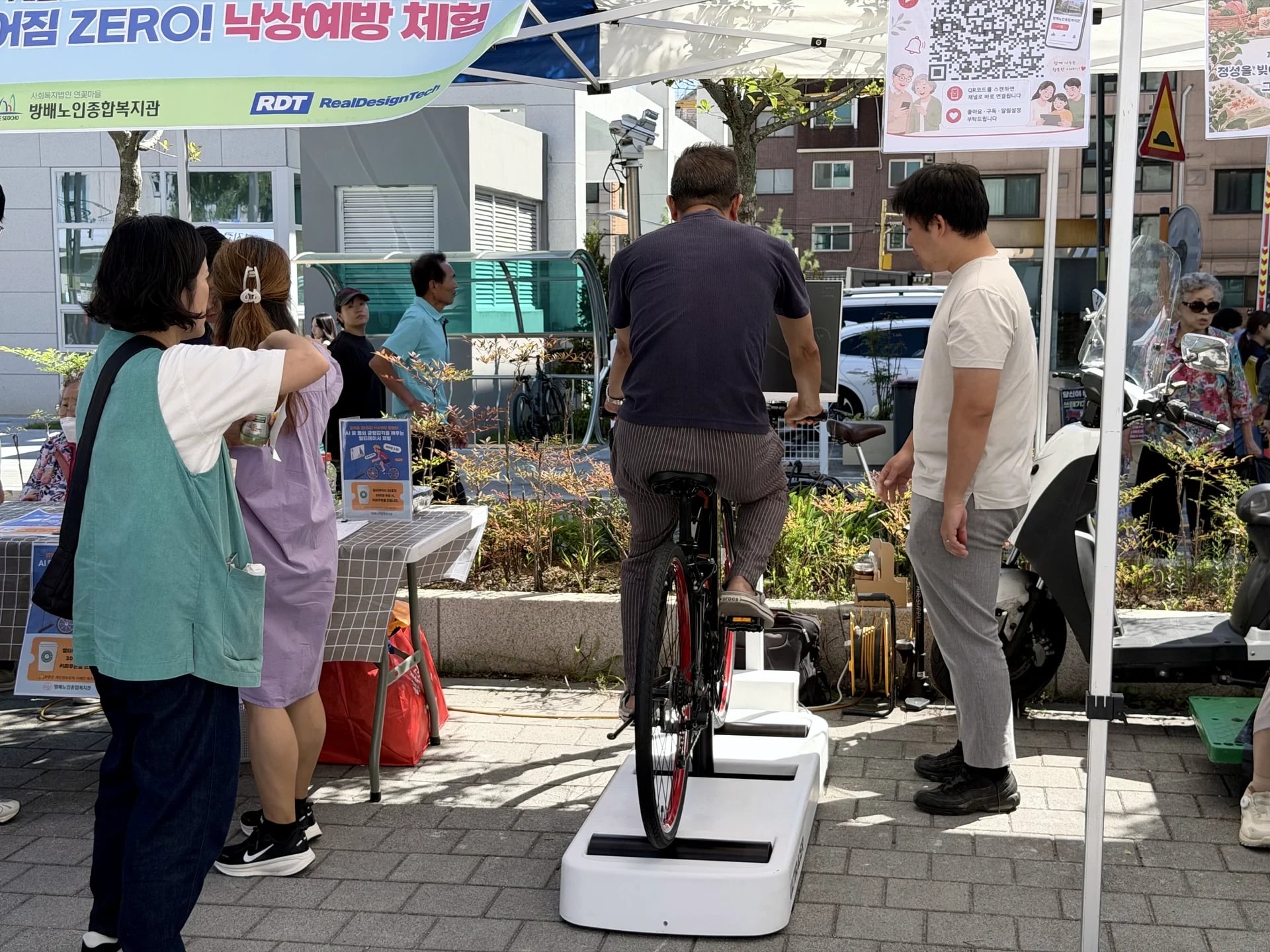
What struck our team was how quickly the hesitation disappeared. A few riders held the handlebars stiffly for the first few seconds, then relaxed as the course unfolded on screen and the bicycle responded to their lean. Grandparents rode while their grandchildren cheered; friends compared results and went back for a second go. The balance-quality score at the end of each ride, out of 100, was a talking point rather than a verdict: the event average was 50, riders in their seventies and over averaged 49, almost exactly the overall figure, and two riders over 70 posted 95 and 100. These are comparative readings against typical riding, not a medical assessment, but they made a point better than any brochure could: age alone does not decide how steadily you ride.
Why falls matter so much in a super-aged Korea
Korea crossed into super-aged status in 2025, when people aged 65 and over reached 20.3% of the population, some 10.5 million people, and Statistics Korea projects that share to pass 30% by 2036 (Newsis, citing Statistics Korea). Falls are the injury that grows with that curve. According to the Korea Disease Control and Prevention Agency's 2024 hospital discharge injury statistics, falls accounted for 52.4% of all injury hospitalisations, and among adults 65 and over they made up 66.4% of injury admissions, with the rate for people 75 and over almost 16 times that of children (Medigate News). Globally, the World Health Organization estimates around 684,000 fatal falls a year and 37.3 million falls serious enough to need medical attention, with death rates highest among adults over 60 (WHO).
The good news is that falls are not simply a fact of ageing. The WHO lists gait, balance and functional training among the interventions that work for older people, and a 2019 Cochrane review of 108 trials with more than 23,000 participants found that exercise programmes reduce the rate of falls by around 23%, with the strongest evidence for programmes built on balance and functional exercises (Cochrane). Balance, in other words, can be trained - and the earlier and more regularly it is trained, the better.
Balance you can see while you ride
That is the gap Ultiracer was built to fill. Most balance training is hard to measure outside a clinic, and most exercise bikes do nothing for balance at all, because the frame never moves. Ultiracer's platform lets the bicycle sway, lean and steer, and our proprietary motion analysis reads those movements in real time, condensing them into the balance-quality score and the sway and coordination readouts the riders in Bangbae watched on screen. The rider simply pedals. The system does the measuring.
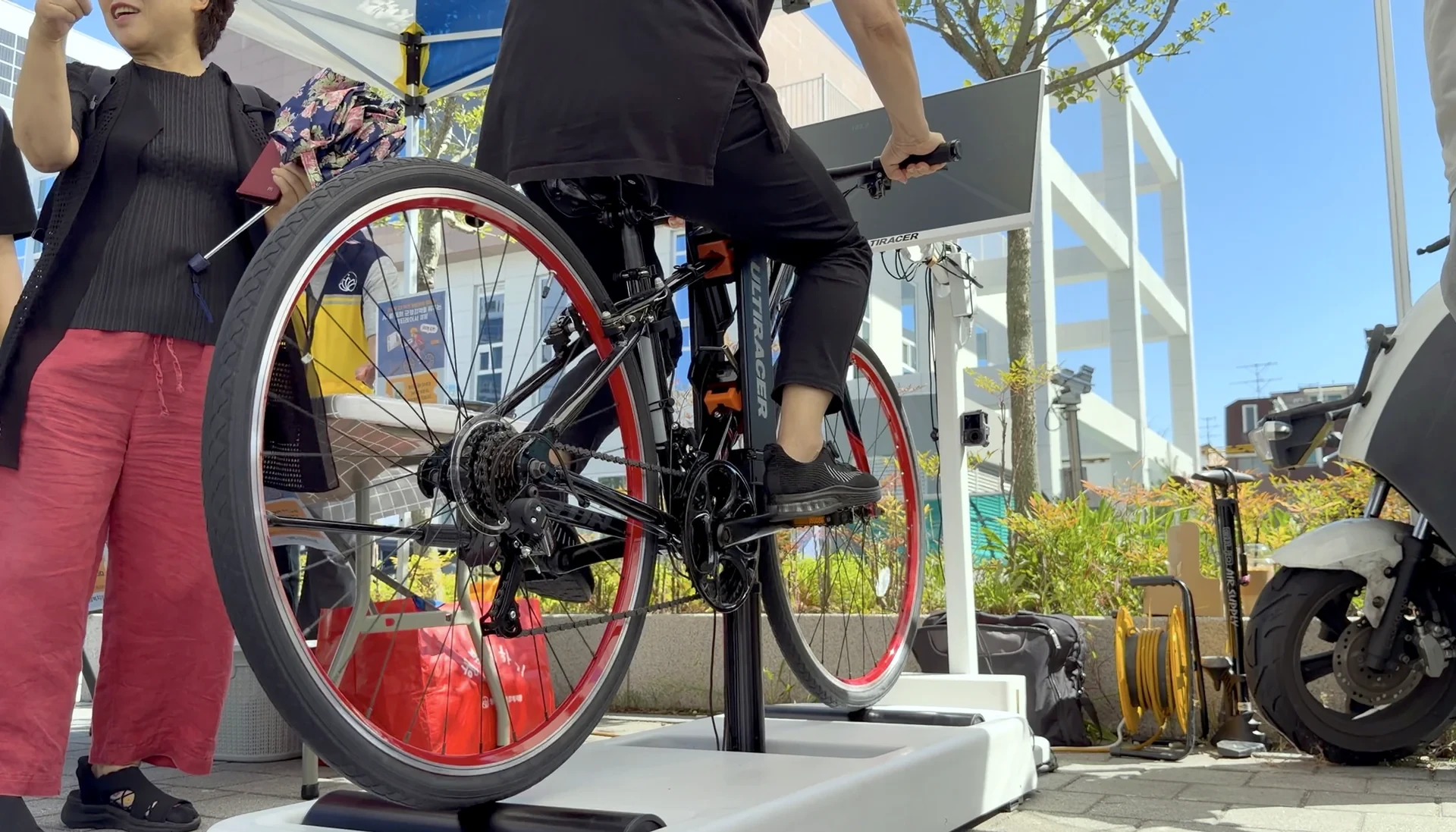
For a senior center, that changes what a short ride can do. A three-minute session is a workout, but it is also a check-in: a rider can see whether today felt steadier than last month, and a wellness guide can see who might benefit from more balance work before a fall ever happens. That is the thinking behind the booth's full title, "Awakening balance and cognition with AI - Zero falls! Fall-prevention experience": exercise that people enjoy enough to repeat, with feedback that makes the benefit visible.
Neurocycling: good for the legs, good for the brain
Balancing a bicycle is a surprisingly demanding task for the brain. It asks the inner ear, the eyes, the joints and the muscles to agree, dozens of times a second, on which way is up, and it does so while the body is moving. That constant negotiation is why we talk about Neurocycling rather than just cycling. It also fits what researchers are finding about cycling and the ageing brain. In an eight-week study by the University of Reading and Oxford Brookes University, adults aged 50 to 83 who cycled regularly improved on measures of executive function and processing speed and reported better mental wellbeing, published in PLOS One in 2019 (University of Reading). The authors were careful to call for larger studies, and so are we. But the direction of the evidence is encouraging, and our research page collects the studies on cycling, balance and cognitive health that guide our work.
You can see what the morning looked like in our short recap from the festival:
YouTube may set cookies when you load this content.
View on YouTube ↗Four units already at work in Bangbae
The best part of the day was that the ride did not have to end when the booth came down. Bangbae Senior Welfare Center operates four Ultiracer units in its fitness room, which means every rider who enjoyed the festival can continue with the same kind of session as part of the center's regular health programme. For us, that is the model we hope to see in many more senior centers: an engaging, measurable way to keep balance and coordination in training week after week, as a habit for life rather than a one-day event. Lifelong exercise is one of the most reliable things anyone can do for healthy ageing, and if a bicycle on a moving platform makes that habit a little more fun, we have done our job.
Thank you, Bangbae
Our sincere thanks go to the staff and volunteers of Bangbae Senior Welfare Center for inviting Ultiracer to the 9th Bangbae-gol 1080 Da-eoullim Festival, for the Dalak Bangbae Bazaar that funds the center's work, and above all to the residents of Bangbae who stepped up to the saddle - especially those in their seventies and eighties who showed everyone watching that balance is for every age. See you in the fitness room.