14 Science-Backed Health Benefits of Cycling at Every Age (Your Brain Will Love No. 7)
By Shaun Cheon
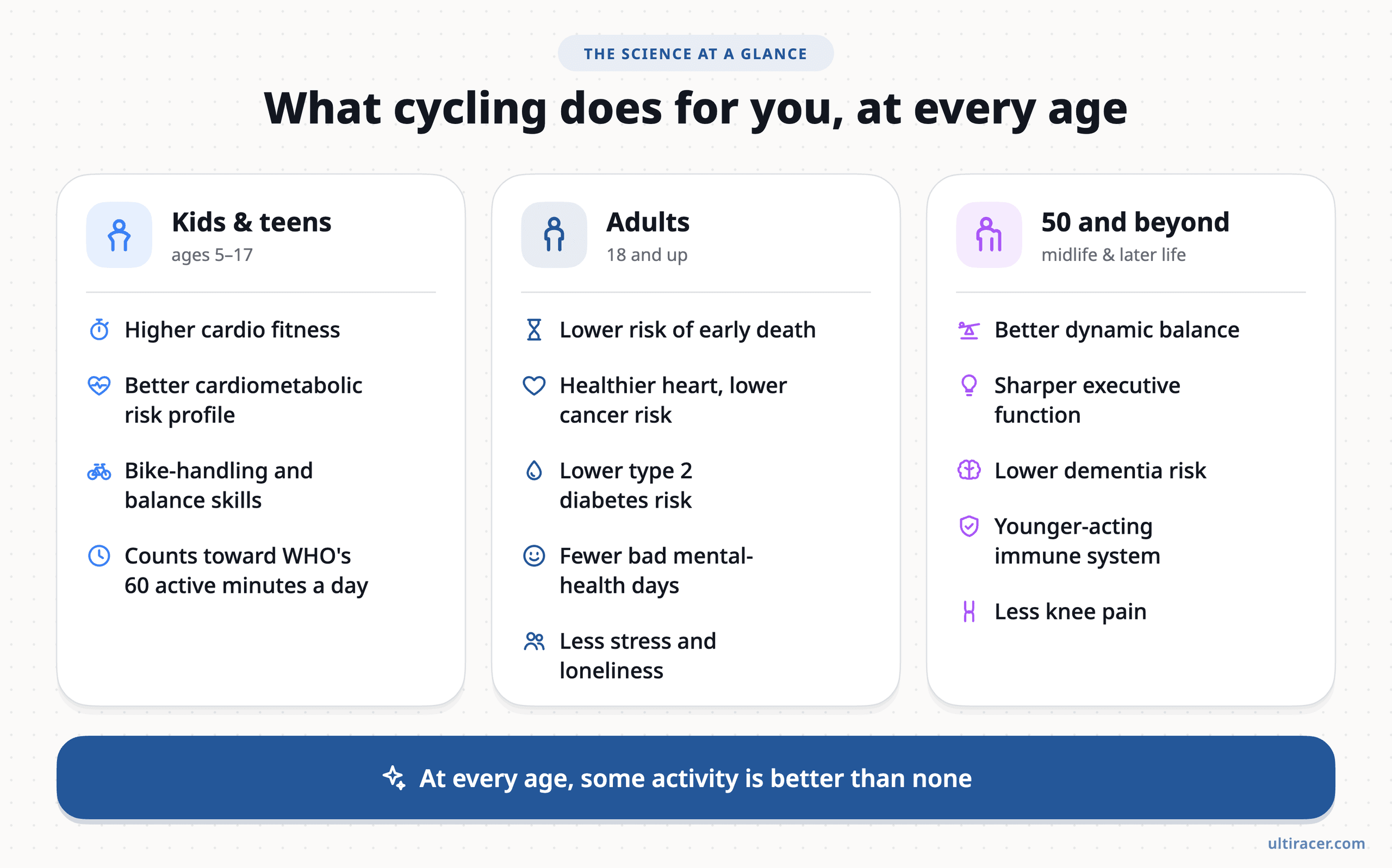
Here is a fun fact for your next family dinner: the same activity that gets a 9-year-old to school can help keep a 79-year-old steady on their feet. Cycling is one of very few kinds of exercise that works at almost every age, and the research behind it goes far beyond "it's good cardio."
We went through large cohort studies, randomized trials and lab experiments and pulled out 14 benefits that hold up. Every claim links straight to its source, and the full References list is at the end. One note before we start: many of the biggest studies are observational, which means they show strong links rather than proof of cause and effect. We flag that wherever it matters.
1. Cycling is linked to a longer life, and the numbers are big
In a study of more than 263,000 adults in the UK Biobank, people who cycled to work had a 41% lower risk of dying from any cause over about five years than people who drove or took public transport. They also had a 46% lower risk of developing heart disease and a 45% lower risk of developing cancer (Celis-Morales et al., 2017). Walking commuters saw heart benefits too, but cycling stood out across every outcome.
The fine print: this was an observational study, so it shows a strong association rather than proof. The researchers did adjust for smoking, diet, body weight and other major factors.
2. It helps keep blood sugar in check, even if you start later in life
A Danish study that followed more than 50,000 adults aged 50 to 65 found that regular cyclists had a lower risk of type 2 diabetes, and the more time they spent riding, the lower the risk. The best news is for late starters: people who took up cycling between the study's two check-ins, about five years apart, had a 20% lower risk than people who did not cycle (Rasmussen et al., 2016).
3. Your knees might actually thank you
Worried that exercise wears out your joints? Among 2,607 people in the Osteoarthritis Initiative, those who had cycled at some point in their lives were 17% less likely to report frequent knee pain and 21% less likely to have symptomatic knee osteoarthritis than people who never cycled. The more stages of life they had cycled through, the stronger the link (Lo et al., 2024). Cycling moves the knee through its full range of motion without the pounding of running, which is why it is so often suggested for people with sore joints.
4. Every ride is a balance workout in disguise
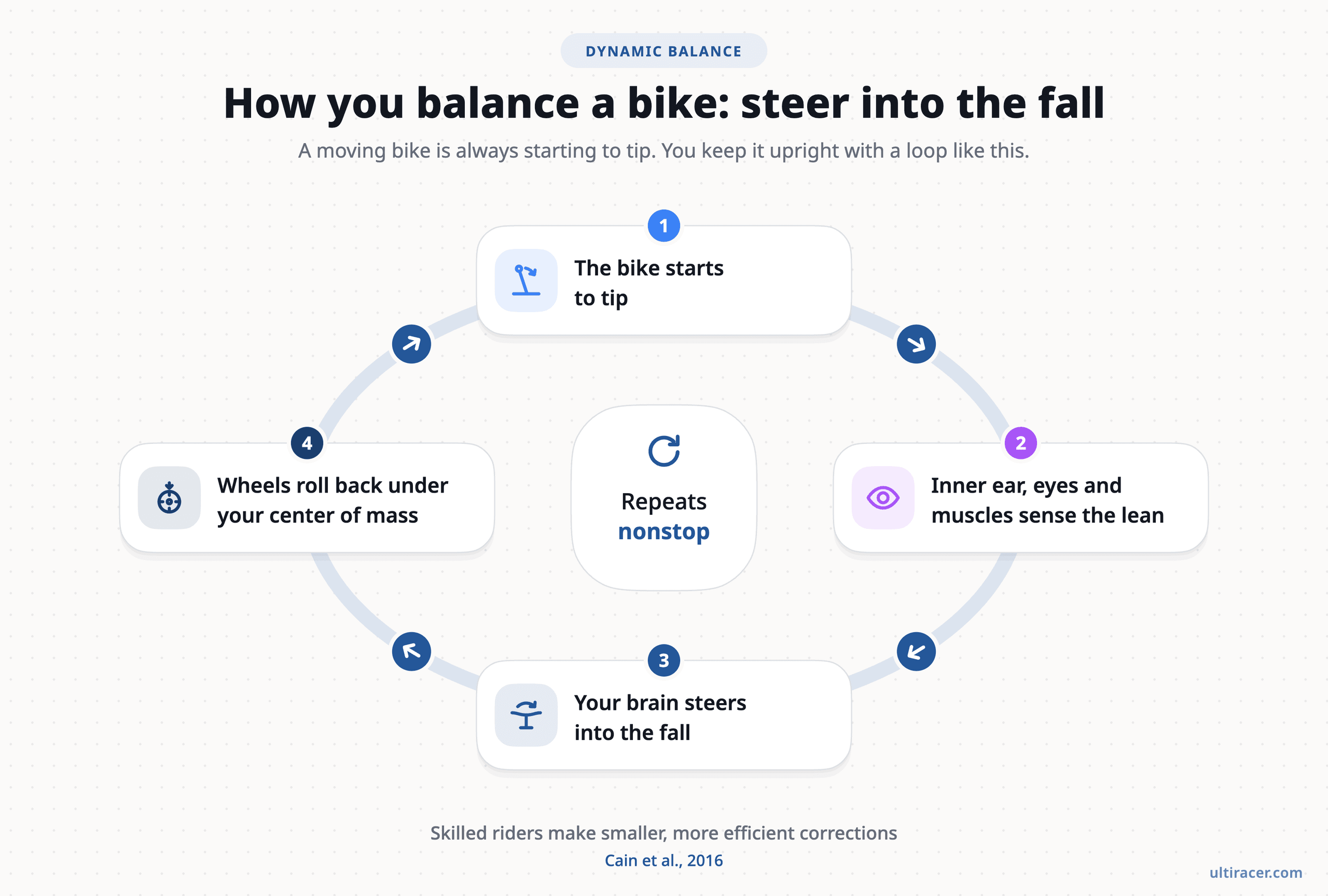
Here is the part most people never think about. A moving bicycle is always starting to tip over, and you keep it upright by steering into the fall so the wheels roll back under your center of mass. That loop of sensing and correcting runs nonstop, and it uses your inner ear, your eyes, the sensors in your muscles and joints, and your brain all at once.
Researchers at the University of Michigan measured this on instrumented bikes and found that skilled riders do not balance less; they balance better. They used smaller, more efficient steering inputs and more effective body lean than novices (Cain et al., 2016). In other words, balance on a bike is a skill you can train, and every ride is practice.
5. That dynamic balance shows up off the bike too
Balance tends to decline with age, and poor balance is one of the strongest risk factors for falls. In a pair of pilot studies, adults aged 49 to 72 who started a 12-week cycling program improved on a test of dynamic balance (how quickly they could step in response to a cue) and on how long they could stand on one leg (Rissel et al., 2013). The studies were small, so treat this as a promising signal rather than a final answer.
It fits with the World Health Organization's guidelines, which recommend that adults aged 65 and over do varied activity that emphasizes balance and strength on at least three days a week to help prevent falls (Bull et al., 2020).
6. It sharpens your thinking, even on an e-bike
In an eight-week study of 100 adults aged 50 to 83, people who rode outdoors three times a week for 30 minutes improved on tests of executive function, the mental skills you use to plan, focus and switch between tasks, compared with people who did not ride. Surprisingly, riders on e-bikes improved as much as riders on pedal bikes, and the e-bike group also improved processing speed and mental wellbeing (Leyland et al., 2019). The researchers think getting outside and navigating the real world matters, not only the physical effort.
7. Add a game to your ride and your brain gets a bonus
This one is our favorite. Researchers randomly assigned older adults aged 58 to 99 in retirement communities to ride either a regular stationary bike or a "cybercycle", a stationary bike with an interactive virtual course and on-screen competitors, for three months. Both groups put in the same physical effort, yet the cybercyclists improved more in executive function, showed a bigger rise in BDNF (a protein linked to brain plasticity) and had a 23% lower relative risk of progressing to mild cognitive impairment (Anderson-Hanley et al., 2012).
The takeaway: moving your body while your brain has decisions to make seems to give you more than either one alone.
8. Cyclists have a lower risk of dementia
A 2025 analysis of nearly 480,000 UK adults followed for a median of 13 years found that people who cycled for everyday trips had a 19% lower risk of dementia and a 22% lower risk of Alzheimer's disease than people who relied on cars or public transport. Brain scans also linked cycling with a larger hippocampus, the region at the center of memory and learning (Hou et al., 2025).
The authors suggest cycling may engage the brain more than walking because it involves balance, route finding and reacting to your surroundings. As with the longevity study above, this is an association from observational data, not proof that cycling prevents dementia.
9. Fewer bad mental-health days
In a study of 1.2 million adults in the United States, people who exercised reported fewer days of poor mental health each month than people who did not. Cycling was one of the standouts, linked with 21.6% fewer bad days, second only to team sports. Sessions of about 45 minutes, three to five times a week, showed the strongest links (Chekroud et al., 2018).
10. Less stress and less loneliness
A study of more than 8,800 people in seven European cities, from London to Rome, compared how people got around with how they felt. Bicycle use was associated with better self-rated health, better mental health, more vitality, lower perceived stress and fewer feelings of loneliness, and cycling came out on top in every analysis (Avila-Palencia et al., 2018).
11. Your immune system may age more slowly
When researchers studied 125 amateur cyclists aged 55 to 79 who had ridden for most of their adult lives, they found that the riders' thymus, the organ that makes immune T cells and normally shrinks from early adulthood, was producing as many new T cells as a young adult's (Duggal et al., 2018). It was a comparison study rather than a trial, but it is a striking picture of what decades of riding can look like.
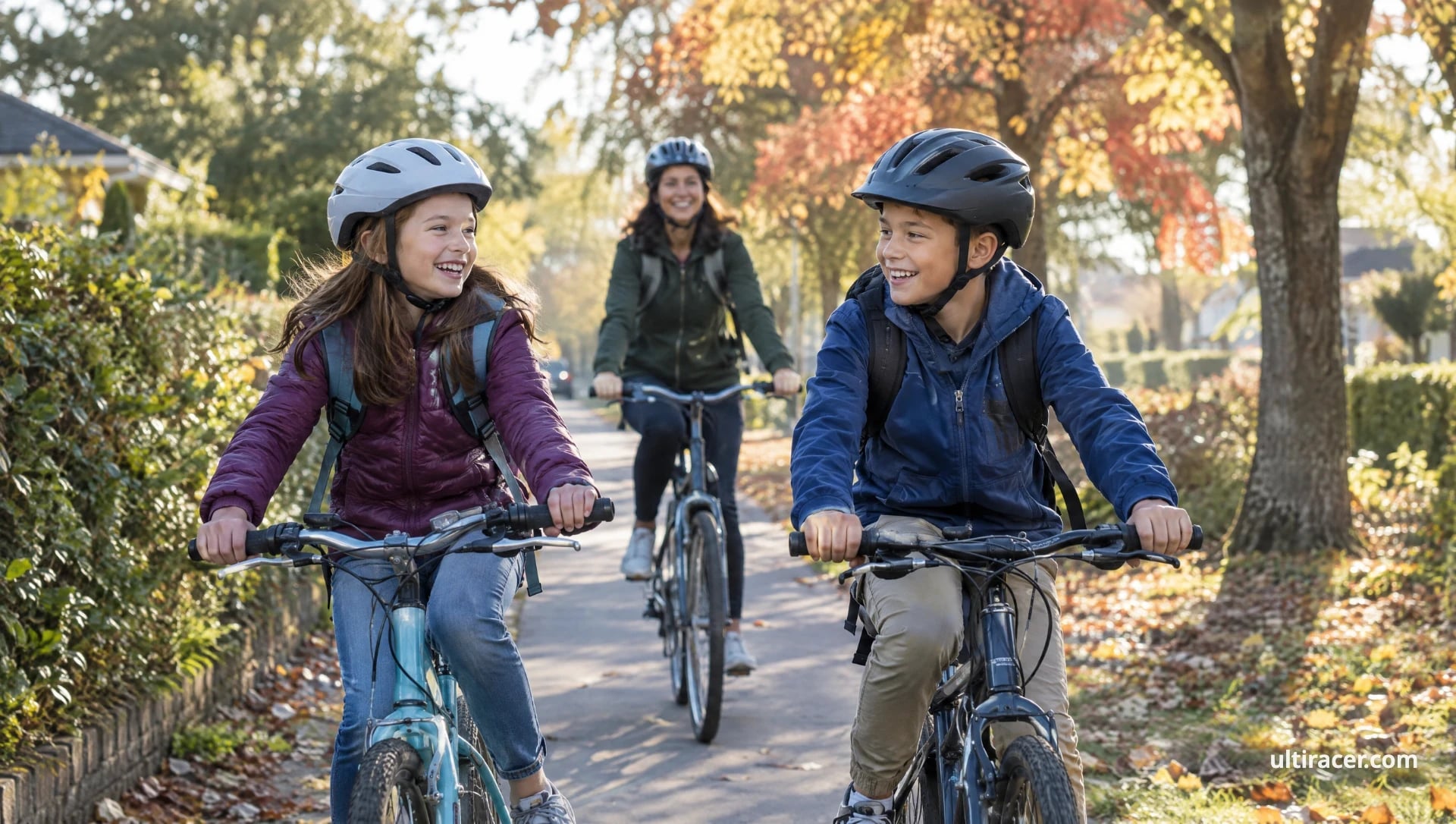
12. For kids, it builds fitness and healthier hearts
Children who cycle to school tend to be fitter than children who walk or are driven (Cooper et al., 2006). And it is not only that fit kids choose to ride: in a randomized trial in Denmark, children assigned to start cycling to school improved their combined cardiometabolic risk score compared with children who did not (Østergaard et al., 2012).
Riding also teaches the balance and bike-handling skills described earlier, and it counts toward the WHO recommendation of an average of 60 minutes of moderate-to-vigorous activity a day for children and teens (Bull et al., 2020).
13. It can help when walking gets hard, including with Parkinson's
In 2010, neurologists in the Netherlands described a man with advanced Parkinson's disease who could barely take a few steps without his gait freezing, yet could ride a bicycle smoothly, and froze again the moment he got off (Snijders & Bloem, 2010).
The same research group later ran a randomized trial with 130 people with mild Parkinson's. Those who rode a stationary bike at home three times a week for six months, guided by a gamified app, saw their motor symptoms worsen far less than a stretching group did, a 4.2-point difference on the standard rating scale (van der Kolk et al., 2019). Brain scans from the trial showed stronger connectivity in movement networks and less overall brain shrinkage in the cycling group (Johansson et al., 2022).
14. It is never too early or too late, and a little still counts
The WHO guidelines are clear on two points that apply at every age: some physical activity is better than none, and more is better (Bull et al., 2020). Cycling makes that easy to act on. A short ride to the shops counts, and as the Danish diabetes study showed, people who start cycling in midlife or later still see the benefits.
The secret ingredient most indoor bikes leave out
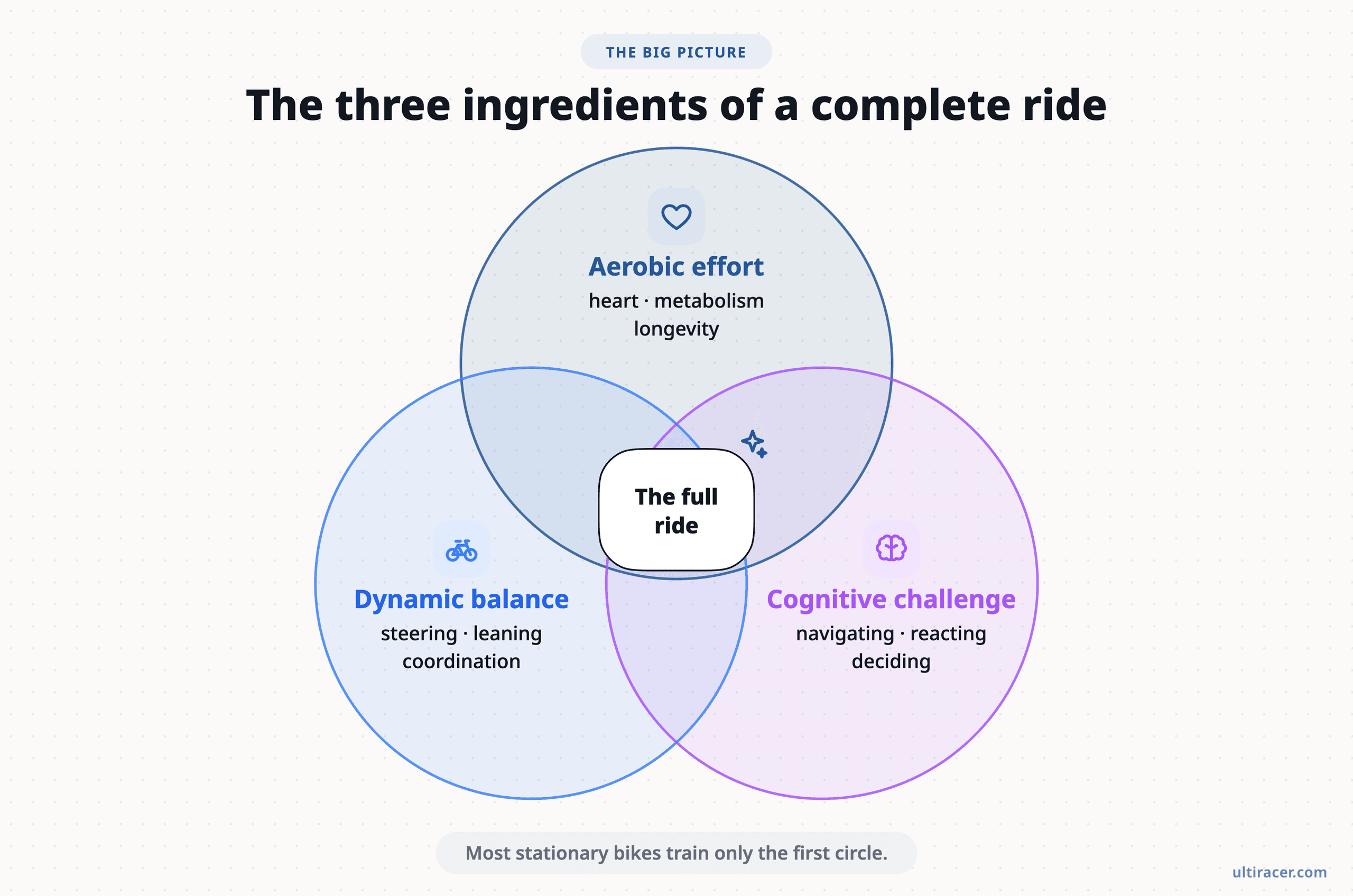
Look back at the list and a pattern appears. The benefits come from three things working together: aerobic effort (a longer life, steadier blood sugar, healthier knees and a better mood), dynamic balance (the steer-into-the-fall loop and steadier footing with age), and a brain that is busy steering, navigating and deciding (sharper thinking, the cybercycle bonus and a lower dementia risk). A typical stationary bike trains only the first. Its frame never leans and never steers, so the balance and brain work of a real ride disappears indoors.
Try the full ride indoors with Ultiracer
That gap is exactly why we built Ultiracer. A real bicycle sits on a platform that leans, sways and steers like a bike on the road, while keeping the rider from ever falling. You steer through virtual courses with your own body instead of a button, and the system measures your balance and coordination as you ride. We call it Neurocycling: aerobic effort, dynamic balance and cognitive challenge in a single ride, safe for first-timers from their teens to their eighties.
Ultiracer is already part of daily routines in senior welfare centers in Seoul, and riders of all ages have tried it at events from the Bangbae-gol 1080 Festival to Dubai K-Fest. Curious how it compares with a regular trainer? Read our indoor cycling comparison.
Ready to feel the difference? Whether you want to try a ride yourself or bring Ultiracer to your gym, senior center, clinic, school or community space, get in touch with us and we will set up a demo.
References
- Anderson-Hanley, C., Arciero, P. J., Brickman, A. M., Nimon, J. P., Okuma, N., Westen, S. C., Merz, M. E., Pence, B. D., Woods, J. A., Kramer, A. F., & Zimmerman, E. A. (2012). Exergaming and older adult cognition: A cluster randomized clinical trial. American Journal of Preventive Medicine, 42(2), 109-119. https://doi.org/10.1016/j.amepre.2011.10.016
- Avila-Palencia, I., Int Panis, L., Dons, E., Gaupp-Berghausen, M., Raser, E., Götschi, T., Gerike, R., Brand, C., de Nazelle, A., Orjuela, J. P., Anaya-Boig, E., Stigell, E., Kahlmeier, S., Iacorossi, F., & Nieuwenhuijsen, M. J. (2018). The effects of transport mode use on self-perceived health, mental health, and social contact measures: A cross-sectional and longitudinal study. Environment International, 120, 199-206. https://doi.org/10.1016/j.envint.2018.08.002
- Bull, F. C., Al-Ansari, S. S., Biddle, S., Borodulin, K., Buman, M. P., Cardon, G., et al. (2020). World Health Organization 2020 guidelines on physical activity and sedentary behaviour. British Journal of Sports Medicine, 54(24), 1451-1462. https://doi.org/10.1136/bjsports-2020-102955
- Cain, S. M., Ashton-Miller, J. A., & Perkins, N. C. (2016). On the skill of balancing while riding a bicycle. PLOS ONE, 11(2), e0149340. https://doi.org/10.1371/journal.pone.0149340
- Celis-Morales, C. A., Lyall, D. M., Welsh, P., Anderson, J., Steell, L., Guo, Y., Maldonado, R., Mackay, D. F., Pell, J. P., Sattar, N., & Gill, J. M. R. (2017). Association between active commuting and incident cardiovascular disease, cancer, and mortality: Prospective cohort study. BMJ, 357, j1456. https://doi.org/10.1136/bmj.j1456
- Chekroud, S. R., Gueorguieva, R., Zheutlin, A. B., Paulus, M., Krumholz, H. M., Krystal, J. H., & Chekroud, A. M. (2018). Association between physical exercise and mental health in 1.2 million individuals in the USA between 2011 and 2015: A cross-sectional study. The Lancet Psychiatry, 5(9), 739-746. https://doi.org/10.1016/S2215-0366(18)30227-X
- Cooper, A. R., Wedderkopp, N., Wang, H., Andersen, L. B., Froberg, K., & Page, A. S. (2006). Active travel to school and cardiovascular fitness in Danish children and adolescents. Medicine & Science in Sports & Exercise, 38(10), 1724-1731. https://doi.org/10.1249/01.mss.0000229570.02037.1d
- Duggal, N. A., Pollock, R. D., Lazarus, N. R., Harridge, S., & Lord, J. M. (2018). Major features of immunesenescence, including reduced thymic output, are ameliorated by high levels of physical activity in adulthood. Aging Cell, 17(2), e12750. https://doi.org/10.1111/acel.12750
- Hou, C., Zhang, Y., Zhao, F., Lv, Y., Luo, M., Pan, C., Ding, D., & Chen, L. (2025). Active travel mode and incident dementia and brain structure. JAMA Network Open, 8(6), e2514316. https://doi.org/10.1001/jamanetworkopen.2025.14316
- Johansson, M. E., Cameron, I. G. M., Van der Kolk, N. M., de Vries, N. M., Klimars, E., Toni, I., Bloem, B. R., & Helmich, R. C. (2022). Aerobic exercise alters brain function and structure in Parkinson's disease: A randomized controlled trial. Annals of Neurology, 91(2), 203-216. https://doi.org/10.1002/ana.26291
- Leyland, L.-A., Spencer, B., Beale, N., Jones, T., & van Reekum, C. M. (2019). The effect of cycling on cognitive function and well-being in older adults. PLOS ONE, 14(2), e0211779. https://doi.org/10.1371/journal.pone.0211779
- Lo, G. H., Richard, M. J., Kriska, A. M., et al. (2024). Bicycling over a lifetime is associated with less symptomatic knee osteoarthritis: Data from the Osteoarthritis Initiative. Medicine & Science in Sports & Exercise, 56(9), 1678-1684. https://doi.org/10.1249/MSS.0000000000003449
- Østergaard, L., Børrestad, L. A. B., Tarp, J., & Andersen, L. B. (2012). Bicycling to school improves the cardiometabolic risk factor profile: A randomised controlled trial. BMJ Open, 2(6), e001307. https://doi.org/10.1136/bmjopen-2012-001307
- Rasmussen, M. G., Grøntved, A., Blond, K., Overvad, K., Tjønneland, A., Jensen, M. K., & Østergaard, L. (2016). Associations between recreational and commuter cycling, changes in cycling, and type 2 diabetes risk: A cohort study of Danish men and women. PLOS Medicine, 13(7), e1002076. https://doi.org/10.1371/journal.pmed.1002076
- Rissel, C., Passmore, E., Mason, C., & Merom, D. (2013). Two pilot studies of the effect of bicycling on balance and leg strength among older adults. Journal of Environmental and Public Health, 2013, 686412. https://doi.org/10.1155/2013/686412
- Snijders, A. H., & Bloem, B. R. (2010). Cycling for freezing of gait. New England Journal of Medicine, 362, e46. https://doi.org/10.1056/NEJMicm0810287
- van der Kolk, N. M., de Vries, N. M., Kessels, R. P. C., Joosten, H., Zwinderman, A. H., Post, B., & Bloem, B. R. (2019). Effectiveness of home-based and remotely supervised aerobic exercise in Parkinson's disease: A double-blind, randomised controlled trial. The Lancet Neurology, 18(11), 998-1008. https://doi.org/10.1016/S1474-4422(19)30285-6