HIIT Training on Ultiracer: Tabata vs HIIT, Explained
By Shaun Cheon
HIIT Training is the interval program in the Ultiracer software suite. Riders alternate hard work intervals with easy recovery, the way coaches and researchers use high-intensity interval training (HIIT), but on a real bicycle that sways and leans like a bike on the road. While they push the pace, they also have to keep the bike upright and centered, so every session trains balance as well as fitness. Every part of the workout can be configured, and every ride ends with an Interval Score that shows how closely the rider followed the program.
This guide explains what Tabata is and how it differs from HIIT, what the research says about the benefits of each, how the program works on Ultiracer, and how to choose safe intervals and heart rate zones for different ages and fitness levels, from beginners to older adults and trained riders.
Tabata vs HIIT: what is the difference?
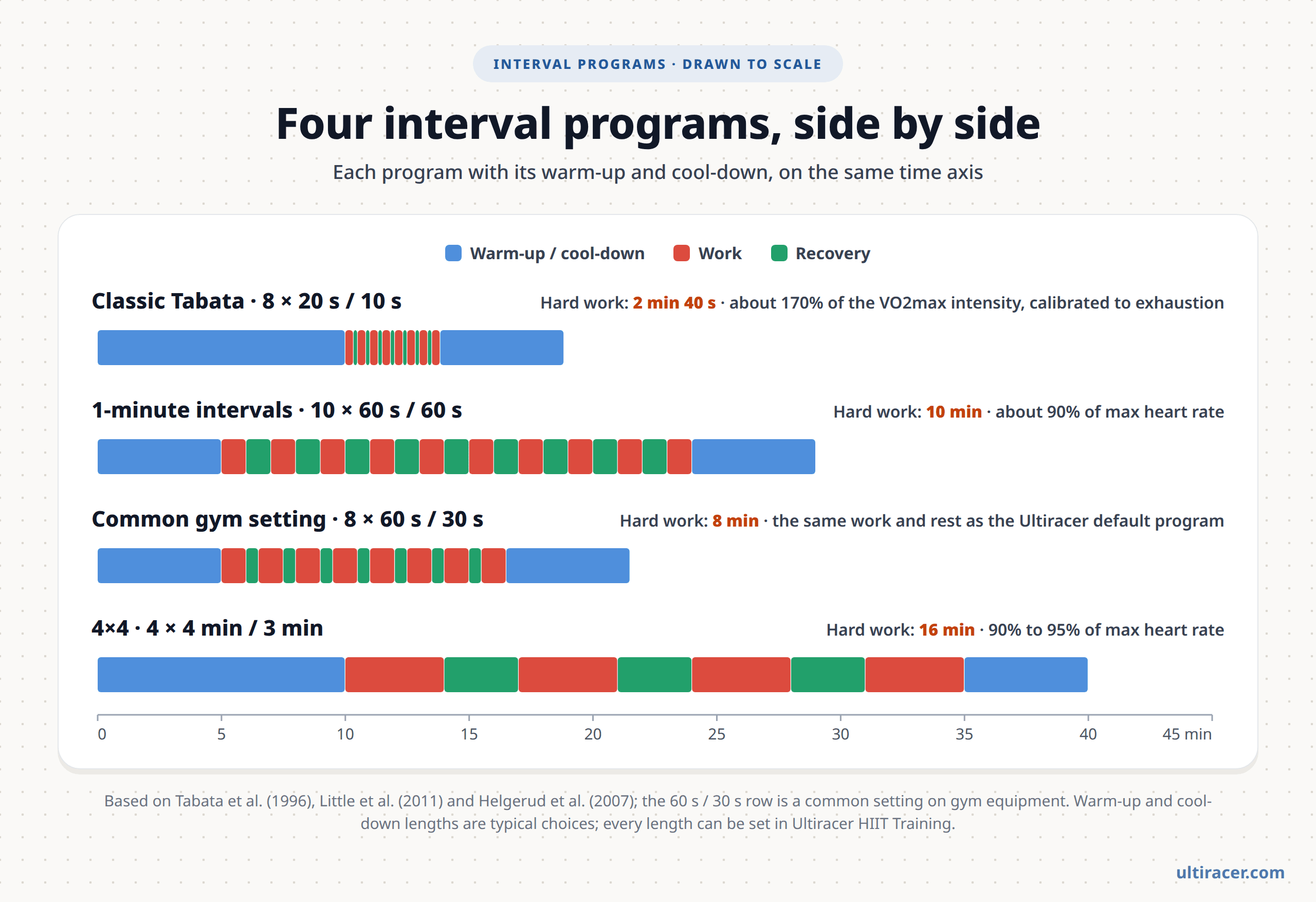
HIIT is a family of workouts: repeated bouts of hard, near-maximal effort separated by periods of recovery. Researchers usually split interval training into two kinds: high-intensity interval training, with near-maximal efforts, and sprint interval training, with supramaximal or all-out efforts above the intensity that brings out a rider's maximal oxygen uptake (MacInnis & Gibala, 2017). Work intervals can last anywhere from a few seconds to several minutes, and recovery can be easy pedaling or full rest.
Tabata is one specific protocol inside that family. In the original 1996 study, Izumi Tabata's team had fit young volunteers pedal a cycle ergometer for 20 seconds at a prescribed workload of about 170% of the intensity that elicits their maximal oxygen uptake (VO2max), held the same in every bout, rest for 10 seconds, and repeat until exhaustion, which came after seven or eight bouts. They trained five days a week for six weeks. Maximal oxygen uptake rose by 7 mL/kg/min and anaerobic capacity by 28%, while a group doing an hour of moderate cycling improved its aerobic fitness but not its anaerobic capacity (Tabata et al., 1996). A follow-up study showed that this protocol taxes both the aerobic and the anaerobic energy systems almost to their maximum (Tabata et al., 1997).
The key word is intensity, and it is calibrated rather than simply maximal. In a 2019 review, Tabata noted that the 20-second/10-second timing has spread widely while the intensity behind it has not, that the method is very demanding, and that it may be best suited to highly motivated athletes. He explained that the intensity should be chosen so that exhaustion arrives around the seventh or eighth bout, and he recommends about 10 minutes of warm-up at roughly half of maximal aerobic capacity before the eight sets (Tabata, 2019). A 20/10 workout ridden at a comfortable pace is still interval exercise, but it is not Tabata training, and neither is sprinting as hard as possible at the start of each bout and then fading.
| Tabata (original protocol) | HIIT (general) | |
|---|---|---|
| Work / recovery | 20 s / 10 s | Usually 30 s to 4 min / 30 s to 4 min |
| Sets | 7 to 8, to exhaustion | Commonly 4 to 10 |
| Intensity | Extremely high, calibrated to exhaustion: about 170% of the VO2max intensity, held in every bout | Near-maximal, typically 80% to 95% of max heart rate |
| Hard work per session | Under 3 minutes, inside a 4-minute block | About 2 to 16 minutes |
| Studied in | Fit young volunteers and athletes | Healthy adults, older adults, people with heart and metabolic conditions |
| Best suited to | Healthy, trained riders who want a short, extremely hard session | Most adults, with intensity and timing set to the person |
Benefits of HIIT and Tabata: what the research says
Fitness gains. In a meta-analysis of 28 controlled trials in 723 healthy adults aged 18 to 45, both continuous endurance training and HIIT produced large improvements in VO2max, and the gains were somewhat larger after HIIT (Milanović et al., 2015). In people with lifestyle-related heart and metabolic conditions, including coronary artery disease, heart failure, high blood pressure and obesity, HIIT raised peak oxygen uptake almost twice as much as moderate continuous training (Weston et al., 2014).
Time. Sedentary men who did three 20-second all-out cycle sprints inside a 10-minute session, three times a week for 12 weeks, improved peak oxygen uptake (by 19%) and insulin sensitivity as much as men who cycled continuously for 45 minutes per session (Gillen et al., 2016). In adults with type 2 diabetes, just six sessions of ten 60-second cycling efforts at about 90% of max heart rate improved 24-hour blood glucose (Little et al., 2011).
Enjoyment. In one study, 11 of 12 recreationally active adults preferred an interval session to a continuous one and rated it more enjoyable, even though it felt harder while they were doing it (Thum et al., 2017).
The trade-offs.
- It is hard. Heart rate, perceived effort and blood lactate are higher, and the moment-to-moment feeling is less pleasant (Thum et al., 2017). Researchers still debate whether people who are currently inactive will adopt and keep up such demanding exercise (Biddle & Batterham, 2015).
- It is not a shortcut to weight loss. Across 13 trials in adults with overweight or obesity, HIIT and moderate continuous training changed body composition by similar amounts, with HIIT taking about 40% less time; the cycling-based programs in that analysis did not reduce fat mass (Wewege et al., 2017).
- Intensity carries some risk. In Norwegian cardiac rehabilitation centers, where 4,846 patients with coronary heart disease trained under supervision, there was one cardiac arrest per 23,182 hours of high-intensity interval exercise and one per 129,456 hours of moderate exercise. The authors judged both risks low in that supervised setting (Rognmo et al., 2012). People who are inactive, or who have symptoms or known heart, metabolic or kidney disease, should get medical clearance before vigorous exercise (Riebe et al., 2015).
Who suits which. Tabata belongs to healthy, already-trained riders who want a short, extremely hard session and are prepared to work to exhaustion. Longer, sub-maximal HIIT suits a much wider group. In the Generation 100 trial, 400 Norwegians aged 70 to 77 were assigned to HIIT at about 90% of peak heart rate twice a week for five years. Mortality in that group trended lower than in the control and moderate-exercise groups, although the difference was not statistically significant (Stensvold et al., 2020). The classic "4×4" format, four minutes at about 90% to 95% of max heart rate with three minutes of active recovery, has improved fitness in healthy adults (Helgerud et al., 2007) and in older patients with heart failure (Wisløff et al., 2007). For someone just starting out, steady moderate exercise remains a perfectly good first step.
An indoor bike HIIT workout: how HIIT Training works on Ultiracer
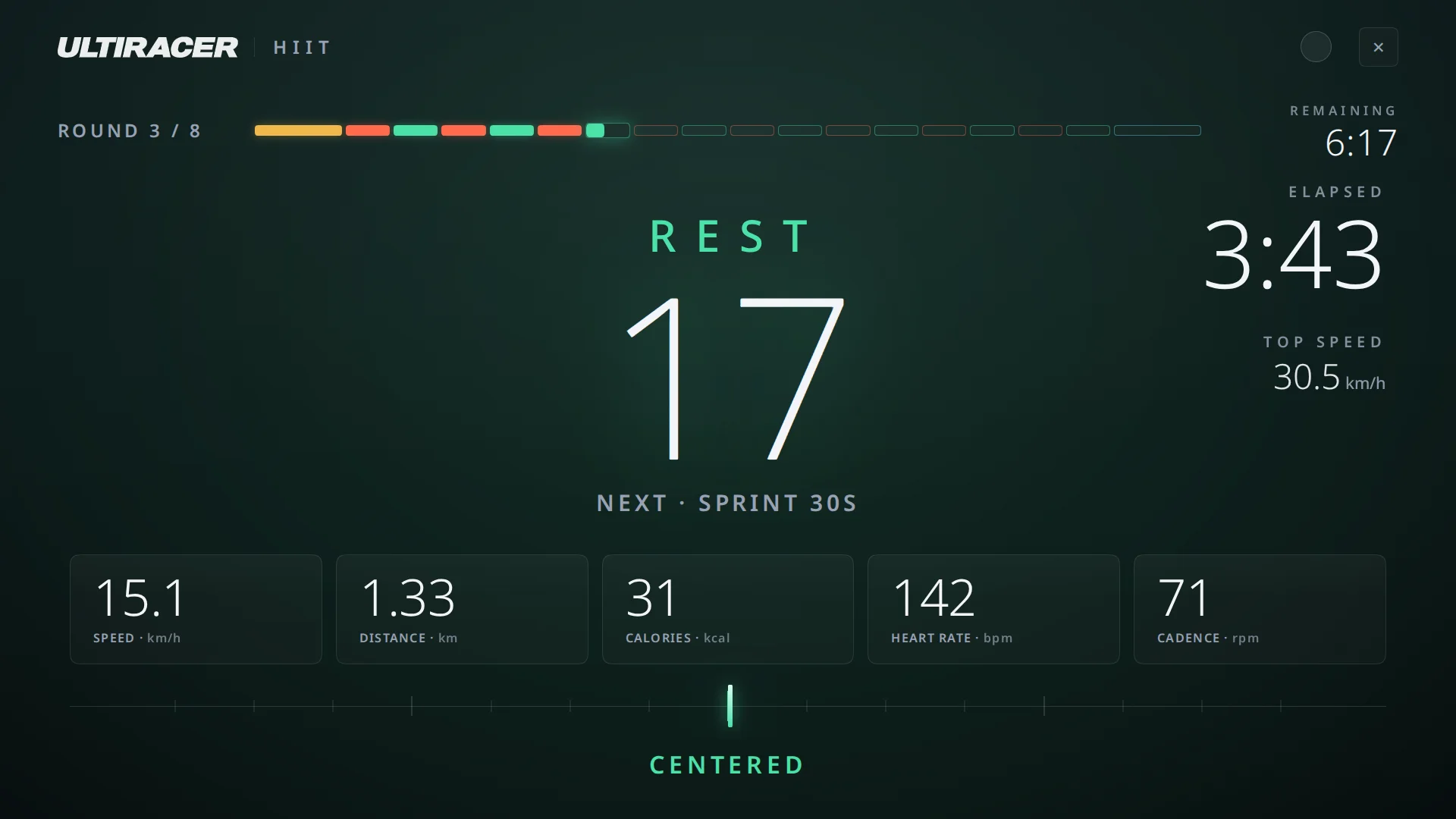
HIIT Training sits in the Ultiracer software suite alongside programs such as Perfect Racer. A rider picks it on the kiosk, chooses a workout if the facility offers more than one, and starts after a 5-4-3-2-1 countdown. The session runs through a warm-up, the work and recovery rounds, and a cool-down, and finishes on a results screen.
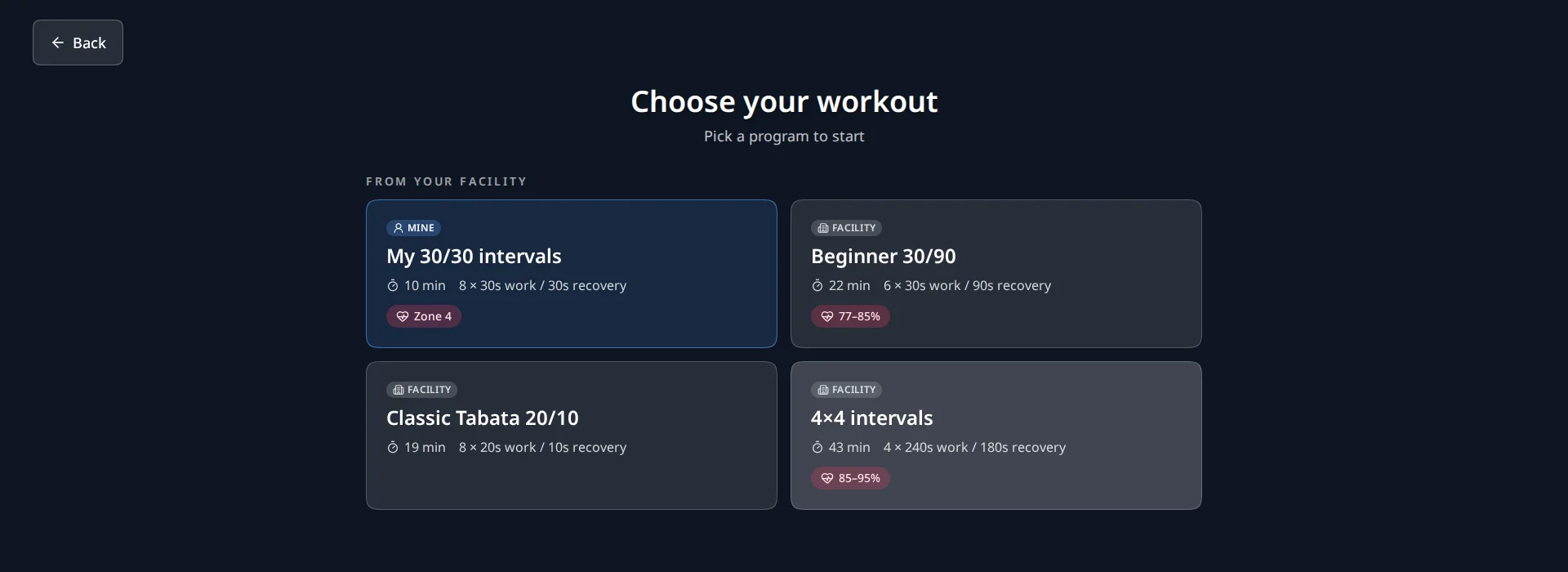
During each interval, the screen shows the phase and a large countdown, what comes next, the round number, the time remaining, and live speed, distance and cadence, plus heart rate when a heart-rate sensor is paired. Sound cues mark every change of phase. Recovery is active: if the rider stops pedaling, the screen reminds them to keep going.
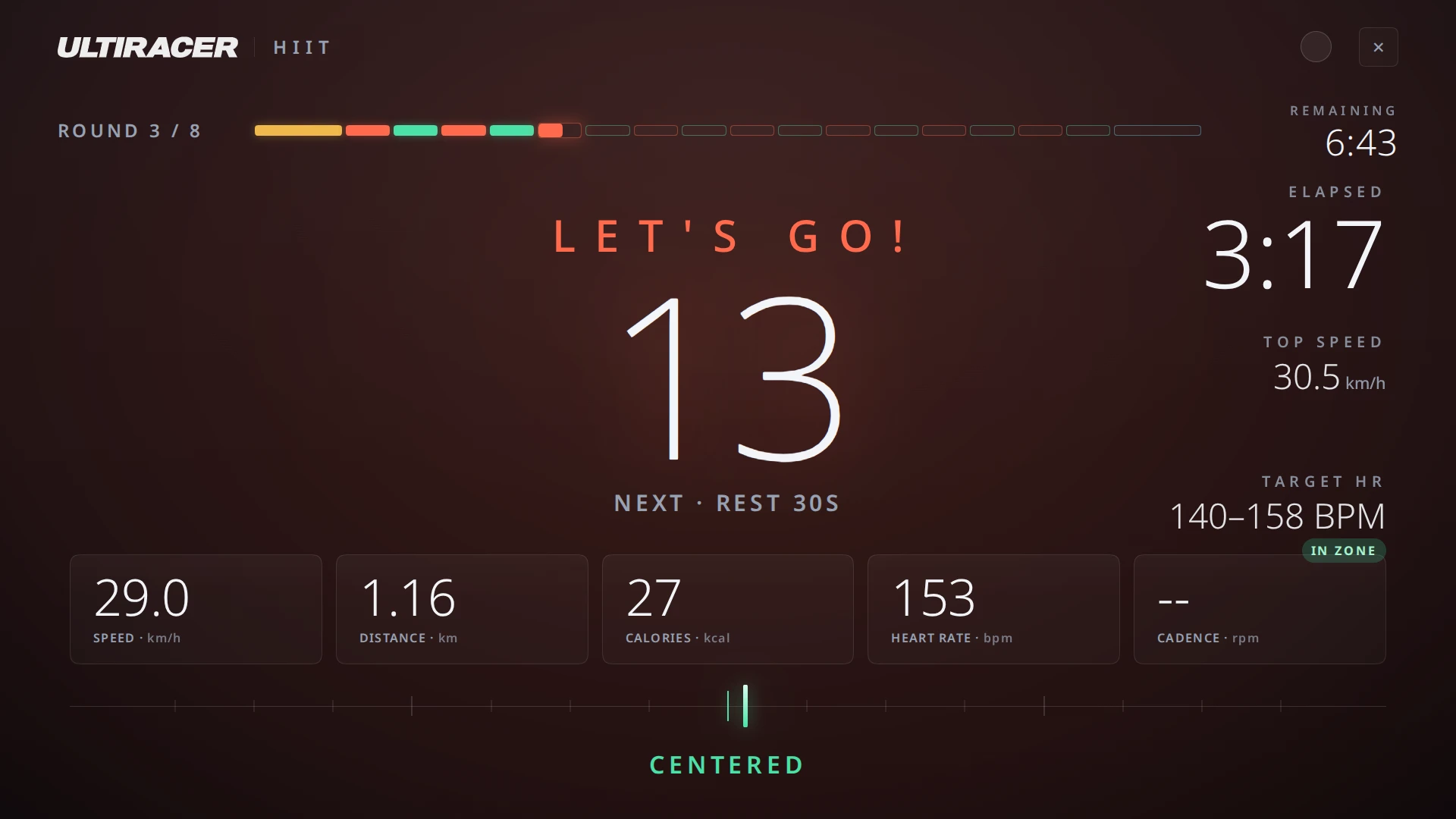
At the bottom of the screen, a balance meter shows where the bike sits from side to side. Because the Ultiracer platform lets the bike sway and lean, the rider has to keep it upright while pedaling hard, and that gets harder as fatigue builds through the rounds. The results screen reports balance next to the Interval Score, so a session counts as balance practice as well as conditioning.
Custom HIIT intervals: work, rest, sets, warm-up and cool-down
Fully customized, individualized workouts are available only on the Ultiracer Kiosk system. On the kiosk, facilities and riders can shape the workout to the person:
- Warm-up: 0 to 10 minutes
- Work interval: 5 seconds to 10 minutes
- Recovery interval: 0 to 10 minutes
- Cool-down: 0 to 10 minutes
- Sets: 1 to 30
Durations move in 5-second steps. The default program is a 14-minute session: a 1-minute warm-up, eight rounds of 60 seconds of work and 30 seconds of recovery (a split you will also find on a lot of gym equipment), and a 1-minute cool-down. The same settings can build a classic Tabata (20/10 × 8), a 4×4, or a gentle 30/90 starter.
Each program can also carry an optional heart-rate target for its work intervals, set as a band of the rider's own maximum heart rate across the standard five zones. When the target is switched on, it defaults to Zone 4, 80% to 90% of max heart rate. The Ultiracer bike does not measure heart rate itself: heart rate and these targets need a separate, third-party Bluetooth heart-rate sensor paired with the kiosk, and we recommend the Polar H10 chest strap for its high accuracy, as well as the Garmin HRM-Fit. With a sensor paired, the screen shows the target in beats per minute during every work interval and tells the rider whether they are in the zone, need to push harder or should ease off. Because the band is a percentage, one program fits every rider: the target is worked out from each rider's own maximum heart rate. That comes from the value saved on the rider's profile or, if none is saved, from their age: 220 minus age for men and 206 minus 0.88 × age for women (Gulati et al., 2010).
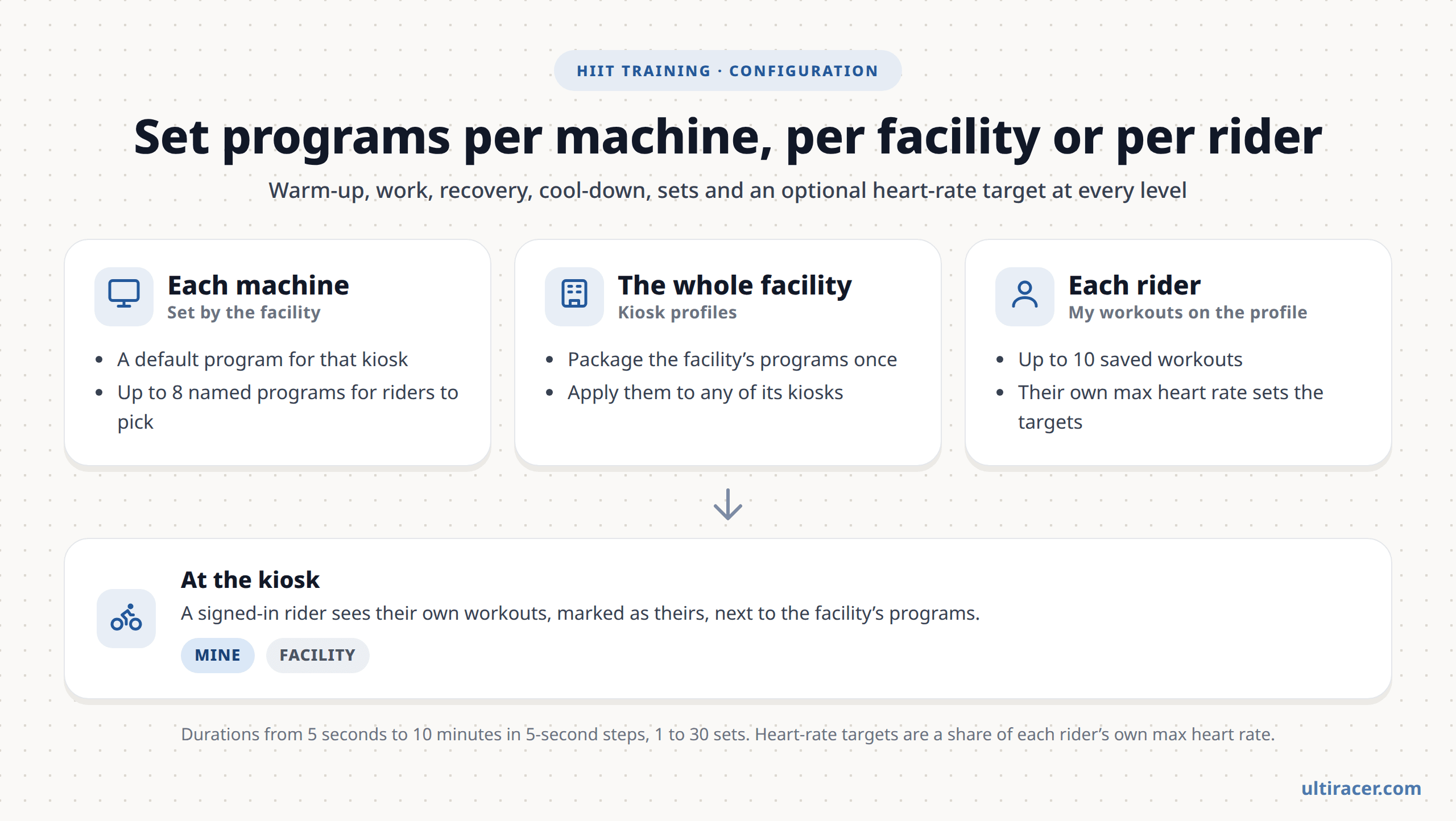
These settings live at three levels:
- On each machine. Every kiosk has its own default program and can hold up to eight named programs for riders to choose from.
- Across a facility. Kiosk profiles let a facility package its programs once and apply them to any of its kiosks.
- For each rider. Riders can save up to ten of their own workouts on their profile. Those workouts appear, marked as theirs, on any kiosk they sign in to, and their saved maximum heart rate sets their personal targets.
The Interval Score: tracking HIIT adherence over time
Every completed ride ends with an Interval Score from 0 to 100. It is not a fitness test, and it does not compare riders with one another. It measures how closely the ride matched the structure of the program, using the rider's own speeds, so it works with or without a heart-rate sensor:
- Intensity contrast: whether work intervals were clearly harder than recovery intervals. A real interval workout needs a clear gap between the two.
- Consistency: whether the rider held their work pace from the first round to the last, or faded. This follows the percentage decrement idea that sports scientists use to measure fatigue across repeated sprints (Glaister et al., 2008).
- Work effort: how much of each work interval the rider spent close to their own working pace, rather than easing off part-way through.
Finishing every round matters too: ending early lowers the score. Scores fall into four bands: Excellent (90 and above), Great (75 and above), Good (60 and above) and Keep building. Warm-up and cool-down do not count, so riders can ease in and out without penalty.
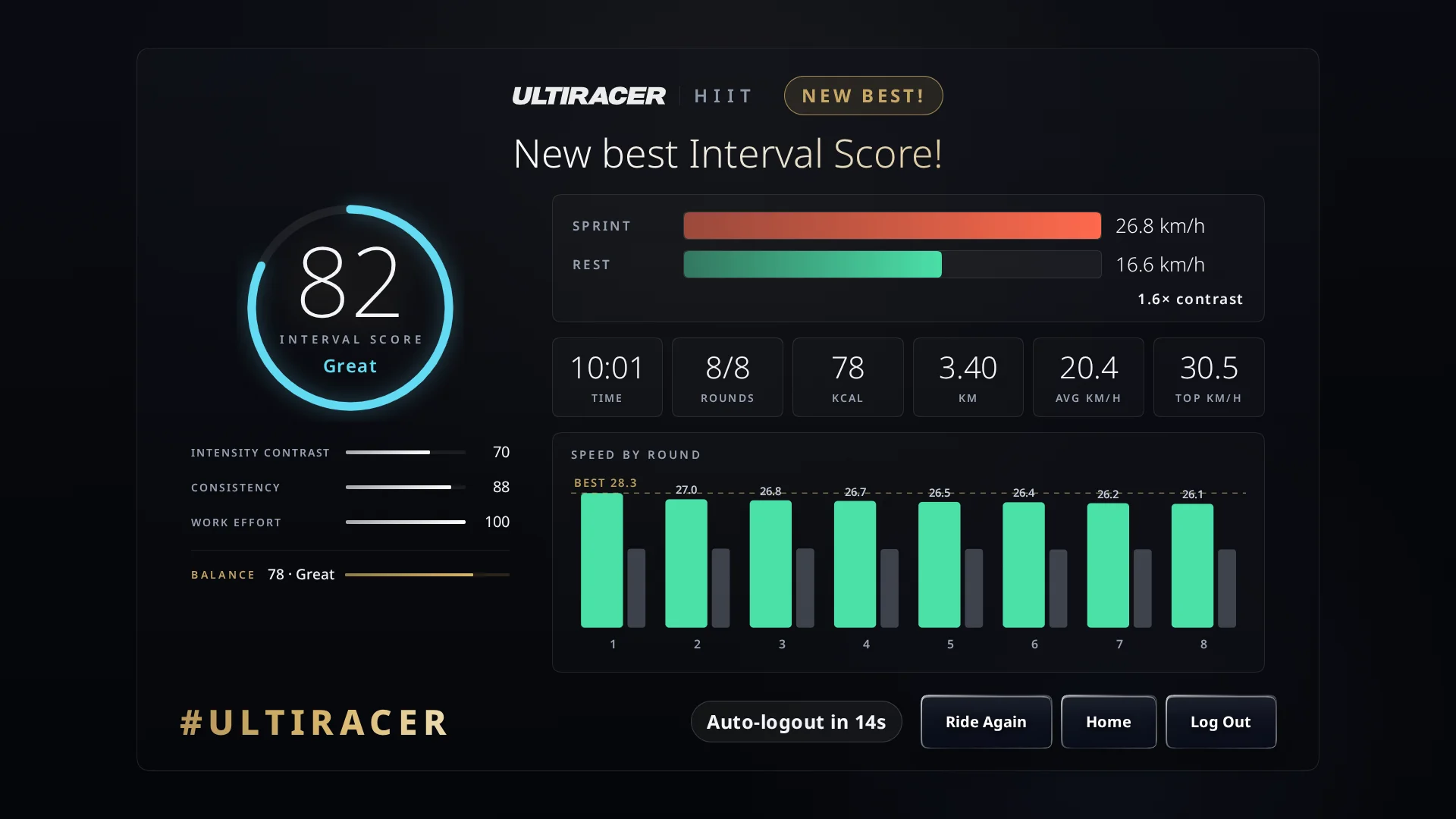
Because the score uses each rider's own speeds, it works at every fitness level and can be tracked over time. Each ride's score is saved with the session, alongside round-by-round splits and a coaching tip, and facility reports show the average score for each program. That gives riders, guides and facilities a measure of adherence to a prescribed program:
- High scores with an easy heart rate suggest the rider is ready to progress: longer work intervals, shorter recovery or more sets.
- Low scores driven by fading consistency or a small work-recovery gap suggest the program is too hard for now: shorter work intervals, longer recovery or fewer sets.
- A steady upward trend shows the rider is settling into the program and doing it as intended.
HIIT heart rate zones by age and fitness level
The tables below are starting points built on published exercise guidance. The American College of Sports Medicine classes 64% to 76% of max heart rate as moderate and 77% to 95% as vigorous, with perceived effort of 14 to 17 on the 6-to-20 Borg scale for vigorous work (Garber et al., 2011). The interval formats come from the studies above. Effort is guided by heart rate and perceived effort rather than fixed speeds, because the speed that feels hard differs from rider to rider. On Ultiracer, the right work speed is the one that brings a rider into their heart-rate band and that they can repeat in every round. The heart-rate targets need a paired heart-rate sensor; riders without one can go by perceived effort instead.
Interval structure by fitness level
| Beginner or returning | Regular exerciser | Trained | |
|---|---|---|---|
| Who it suits | New to intervals, or returning after a long break | Active at least three days a week | Months of regular vigorous exercise, no symptoms |
| Work / recovery | 30 s / 90 s | 60 s / 60 s, then 60 s / 30 s as it gets easier | 4 min / 3 min (4×4); Tabata 20 s / 10 s for healthy, trained riders only |
| Sets | 4 to 6 | 6 to 10 | 4 (4×4); 8 (Tabata) |
| Warm-up / cool-down | 5 to 10 min / 5 min | 5 to 10 min / 5 min | 10 min / 5 to 10 min |
| Work heart rate | 77% to 85% of max | 80% to 90% of max | 85% to 95% of max; Tabata works above these zones, calibrated to exhaustion |
| Work effort (Borg 6–20) | 14 to 15, somewhat hard to hard | 15 to 17, hard | 16 to 18 (4×4); 19 to 20 (Tabata) |
| Work speed | A brisk pace you can repeat in every set | Hard but repeatable, the same in every set | The fastest pace you can hold for the full 4 minutes; for Tabata, one very hard pace held in every set, chosen so that you can last only to about the seventh or eighth |
| Recovery speed | Easy spinning, about half your work speed | Easy spinning, about half your work speed | Easy spinning at 60% to 70% of max heart rate; keep the pedals turning through Tabata's 10 s |
| Sessions per week | 2, not on consecutive days | 2 to 3 | 2 to 3 |
| Based on | ACSM intensity ranges; gradual progression | Little et al., 2011 | Helgerud et al., 2007; Tabata et al., 1996 |
Heart-rate targets by age: men (beats per minute)
| Age | Estimated max | Beginner work (77–85%) | Regular work (80–90%) | Trained work (85–95%) | Recovery (60–70%) |
|---|---|---|---|---|---|
| 20 | 200 | 154–170 | 160–180 | 170–190 | 120–140 |
| 30 | 190 | 146–162 | 152–171 | 162–180 | 114–133 |
| 40 | 180 | 139–153 | 144–162 | 153–171 | 108–126 |
| 50 | 170 | 131–144 | 136–153 | 144–162 | 102–119 |
| 60 | 160 | 123–136 | 128–144 | 136–152 | 96–112 |
| 70 | 150 | 116–128 | 120–135 | 128–142 | 90–105 |
Heart-rate targets by age: women (beats per minute)
| Age | Estimated max | Beginner work (77–85%) | Regular work (80–90%) | Trained work (85–95%) | Recovery (60–70%) |
|---|---|---|---|---|---|
| 20 | 188 | 145–160 | 150–169 | 160–179 | 113–132 |
| 30 | 180 | 139–153 | 144–162 | 153–171 | 108–126 |
| 40 | 171 | 132–145 | 137–154 | 145–162 | 103–120 |
| 50 | 162 | 125–138 | 130–146 | 138–154 | 97–113 |
| 60 | 153 | 118–130 | 122–138 | 130–145 | 92–107 |
| 70 | 144 | 111–122 | 115–130 | 122–137 | 86–101 |
The maximums use the same formulas as the Ultiracer program: 220 minus age for men and 206 minus 0.88 × age for women. To use the tables, choose the column for your fitness level, not your age; age is already built into the heart-rate numbers.
A few cautions:
- Age formulas are estimates. Individual maximum heart rates vary widely, and 220 minus age tends to underestimate it in older adults (Tanaka et al., 2001). A measured maximum saved to the rider's profile makes every target more accurate.
- Some medicines blunt heart rate. Beta-blockers are one example. For riders taking them, perceived effort is the better guide, and clinical guidelines recommend combining heart rate with perceived effort in any case (Taylor et al., 2019).
- Progress one step at a time. Add a set, lengthen the work interval or shorten the recovery, never all three at once, and let the Interval Score show whether the change was manageable.
- Get checked first if needed. Anyone who is inactive, has symptoms or has known heart, metabolic or kidney disease should be cleared by a clinician before vigorous intervals (Riebe et al., 2015). Stop at once if you feel chest pain, unusual breathlessness, dizziness or palpitations.
This guide offers general exercise information, not medical advice.
Frequently asked questions about Tabata and HIIT
Is Tabata a type of HIIT? Yes. Tabata is one specific protocol within interval training: eight 20-second bouts with 10 seconds of rest, at an extremely high intensity calibrated so that exhaustion comes around the seventh or eighth bout (Tabata, 2019). Most classes labeled "Tabata" borrow the 20/10 timing at a lower intensity, which makes them general HIIT.
Which is better, Tabata or HIIT? Neither is better for everyone. Tabata suits healthy, trained people who want a very short, extremely hard session. Longer, sub-maximal HIIT, such as 60/60 intervals or the 4×4 format, suits a much wider range of adults, including older adults.
How many times a week should you do HIIT? Most of the training studies cited in this guide used two or three HIIT sessions a week, which is a sensible range for most riders. Beginners can start with two sessions on non-consecutive days.
What heart rate should you aim for during HIIT? For work intervals, a common target is 80% to 90% of maximum heart rate, lower (77% to 85%) for beginners and higher (85% to 95%) for trained riders. Maximum heart rate can be estimated as 220 minus age for men and 206 minus 0.88 × age for women; the tables above turn these into beats per minute by age. On Ultiracer, heart-rate targets need a paired heart-rate sensor.
Is HIIT safe for older adults? It can be, with the right starting point. In the Generation 100 trial, adults aged 70 to 77 did HIIT twice a week for five years (Stensvold et al., 2020), and event rates were low in supervised cardiac rehabilitation (Rognmo et al., 2012). Anyone who is inactive, has symptoms or has known heart, metabolic or kidney disease should get medical clearance first (Riebe et al., 2015) and start with the beginner structure above.
Can you do HIIT on a stationary bike? Yes. Cycling is the classic mode for HIIT research: the original Tabata study and the Gillen and Little studies above all used stationary cycle ergometers. Pedaling is also low-impact compared with running. On Ultiracer, the bike also sways and leans, so every interval session doubles as balance practice.
How long is a Tabata workout? The intervals take 4 minutes: eight rounds of 20 seconds of work and 10 seconds of rest. With the roughly 10-minute warm-up Tabata recommends and a cool-down, a full session takes about 20 minutes.
Try HIIT Training
HIIT Training is part of the Ultiracer software suite. Interested in interval programs for your facility, or in personalized programs for your members? Get in touch with us.
References
- Biddle SJH, Batterham AM. High-intensity interval exercise training for public health: a big HIT or shall we HIT it on the head? Int J Behav Nutr Phys Act. 2015;12:95. PubMed
- Garber CE, et al. American College of Sports Medicine position stand: quantity and quality of exercise for developing and maintaining cardiorespiratory, musculoskeletal, and neuromotor fitness in apparently healthy adults. Med Sci Sports Exerc. 2011;43(7):1334–1359. PubMed
- Gillen JB, et al. Twelve weeks of sprint interval training improves indices of cardiometabolic health similar to traditional endurance training despite a five-fold lower exercise volume and time commitment. PLoS One. 2016;11(4):e0154075. PubMed
- Glaister M, et al. The reliability and validity of fatigue measures during multiple-sprint work: an issue revisited. J Strength Cond Res. 2008;22(5):1597–1601. PubMed
- Gulati M, et al. Heart rate response to exercise stress testing in asymptomatic women: the St. James Women Take Heart Project. Circulation. 2010;122(2):130–137. PubMed
- Helgerud J, et al. Aerobic high-intensity intervals improve VO2max more than moderate training. Med Sci Sports Exerc. 2007;39(4):665–671. PubMed
- Little JP, et al. Low-volume high-intensity interval training reduces hyperglycemia and increases muscle mitochondrial capacity in patients with type 2 diabetes. J Appl Physiol. 2011;111(6):1554–1560. PubMed
- MacInnis MJ, Gibala MJ. Physiological adaptations to interval training and the role of exercise intensity. J Physiol. 2017;595(9):2915–2930. PubMed
- Milanović Z, Sporiš G, Weston M. Effectiveness of high-intensity interval training (HIT) and continuous endurance training for VO2max improvements: a systematic review and meta-analysis of controlled trials. Sports Med. 2015;45(10):1469–1481. PubMed
- Riebe D, et al. Updating ACSM's recommendations for exercise preparticipation health screening. Med Sci Sports Exerc. 2015;47(11):2473–2479. PubMed
- Rognmo Ø, et al. Cardiovascular risk of high- versus moderate-intensity aerobic exercise in coronary heart disease patients. Circulation. 2012;126(12):1436–1440. PubMed
- Stensvold D, et al. Effect of exercise training for five years on all cause mortality in older adults: the Generation 100 study. BMJ. 2020;371:m3485. PubMed
- Tabata I, et al. Effects of moderate-intensity endurance and high-intensity intermittent training on anaerobic capacity and VO2max. Med Sci Sports Exerc. 1996;28(10):1327–1330. PubMed
- Tabata I, et al. Metabolic profile of high intensity intermittent exercises. Med Sci Sports Exerc. 1997;29(3):390–395. PubMed
- Tabata I. Tabata training: one of the most energetically effective high-intensity intermittent training methods. J Physiol Sci. 2019;69(4):559–572. PubMed
- Tanaka H, Monahan KD, Seals DR. Age-predicted maximal heart rate revisited. J Am Coll Cardiol. 2001;37(1):153–156. PubMed
- Taylor JL, et al. Guidelines for the delivery and monitoring of high intensity interval training in clinical populations. Prog Cardiovasc Dis. 2019;62(2):140–146. PubMed
- Thum JS, et al. High-intensity interval training elicits higher enjoyment than moderate intensity continuous exercise. PLoS One. 2017;12(1):e0166299. PubMed
- Weston KS, Wisløff U, Coombes JS. High-intensity interval training in patients with lifestyle-induced cardiometabolic disease: a systematic review and meta-analysis. Br J Sports Med. 2014;48(16):1227–1234. PubMed
- Wewege M, et al. The effects of high-intensity interval training vs. moderate-intensity continuous training on body composition in overweight and obese adults: a systematic review and meta-analysis. Obes Rev. 2017;18(6):635–646. PubMed
- Wisløff U, et al. Superior cardiovascular effect of aerobic interval training versus moderate continuous training in heart failure patients: a randomized study. Circulation. 2007;115(24):3086–3094. PubMed