Ultiracer Joins a Community Exercise Program for Older Adults in Kuki, Japan
By Shaun Cheon
In early 2025, Ultiracer became part of a community exercise program for older adults in Kuki City, Saitama Prefecture. From January to March, the city worked with Air Digital Co., Ltd., which presents Ultiracer in Japan, and Hazama Ando Corporation on a frailty-prevention program that combined guided exercise with digital sports machines (Kuki City, 2025; Air Digital, 2025a).
Frailty (フレイル in Japanese) describes the gradual loss of strength, mobility and energy that can come with age. Many Japanese cities run programs that help older residents stay active before they need care, and Kuki City wanted to see how digital tools could fit into one. Air Digital wrote up the program in a detailed evaluation report, which the city published alongside its announcement (Air Digital, 2025b). This post walks through how the program worked, how it was evaluated and what the results can and cannot tell us.
The setting
The sessions took place at SPORTS60&SMART, an exercise facility on the first floor of the Ario Washinomiya shopping centre in Kuki that offers interactive sports machines for baseball, soccer and cycling (Air Digital, 2025a).
Who took part
According to the city, 39 residents aged 68 to 86 took part, none of whom were certified as needing long-term care. They came once a week for about an hour, for six sessions in total (Kuki City, 2025).
Air Digital's report adds a profile of the group. The largest age band was 75 to 79, most participants had a healthy body weight, most described themselves as healthy, and the most common answer for going out was five or six days a week (Air Digital, 2025b). In other words, these were active older adults living independently, not people already receiving care. The report contradicts itself on the mix of men and women, saying in one place that most participants were women and in another that most were men.
Attendance varied. Of the 39, 18 came to all six sessions, 6 came to five, 3 came to four, 8 came to three and 4 came once or twice. The report notes that a number of people dropped out because they were unwell, which it puts down to the time of year.
How a session ran
The report describes the same structure for each visit (Air Digital, 2025b):
- Frailty-prevention talk (first session only)
- Physical checks (first and last sessions)
- Warm-up (10 minutes)
- Strength training on fitness machines (15 minutes)
- Digital sports machines (15 minutes)
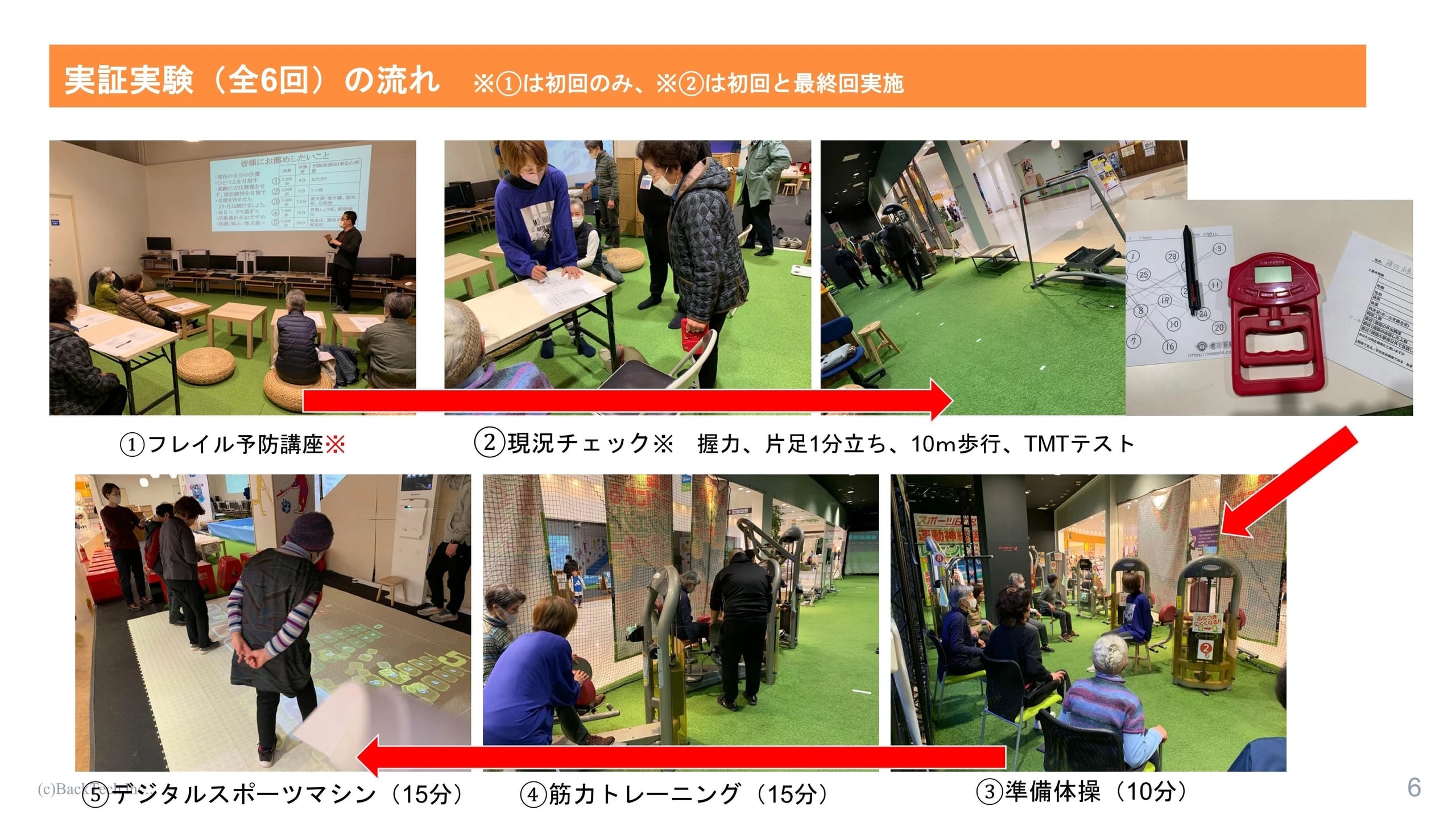
Air Digital explains why the digital part sits alongside the rest: digital machines alone cannot fully build strength or joint range of motion, so the program pairs them with warm-ups, fitness machines and guided exercise (Air Digital, 2025a).
Where Ultiracer fit in
The report names two digital sports machines. One is Ultiracer, listed as a digital bike. The other is DIDIM, a floor-projected game platform, for which the program chose five games: reading a clock, simple sums, picking the larger of two numbers, stomping on bugs and remembering pictures (Air Digital, 2025b).
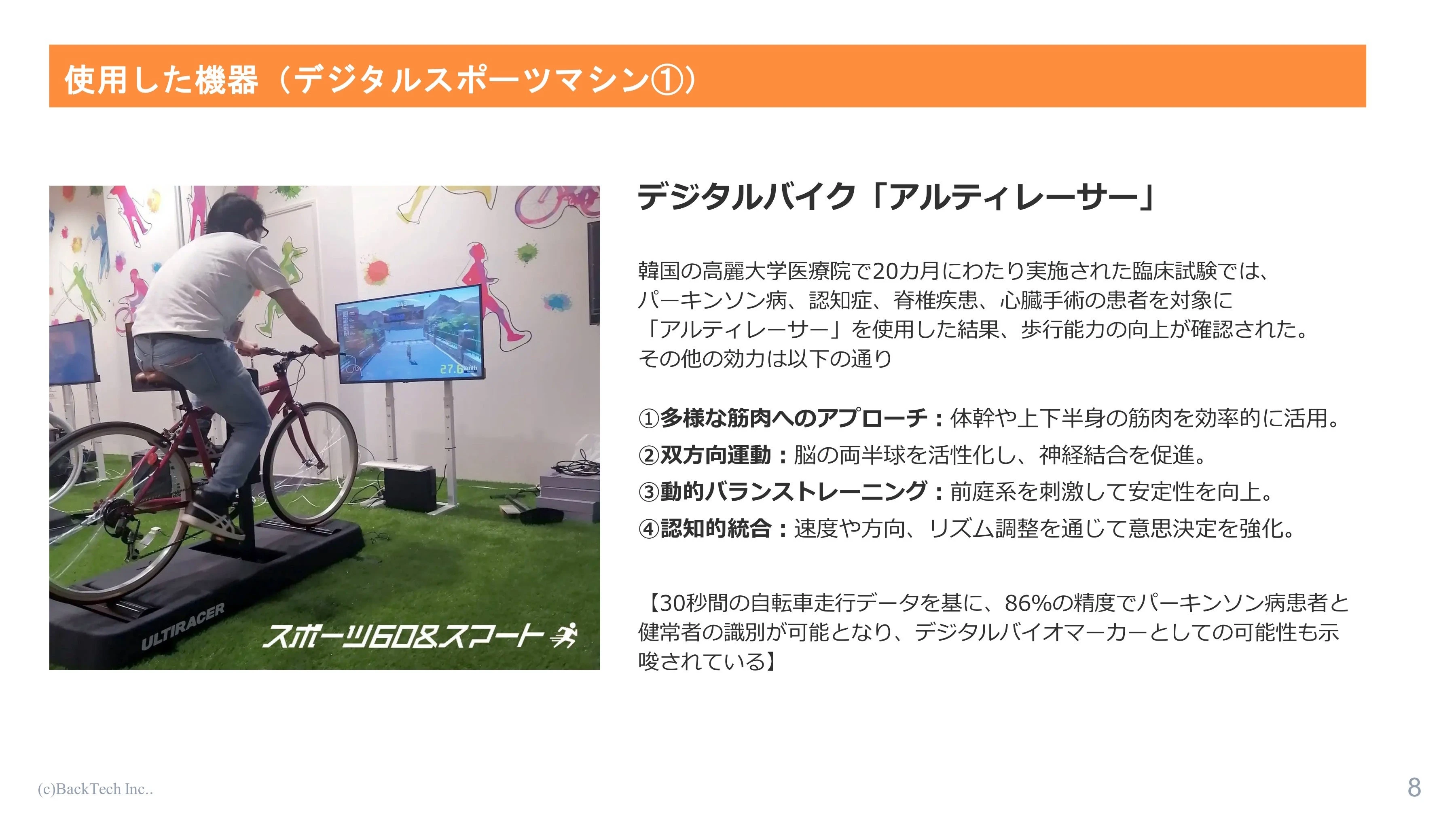
On Ultiracer, participants ride a real bicycle that is held upright on a platform, so they can pedal and steer through a virtual course on screen without worrying about tipping over. The report does not say how much of the 15-minute digital block each participant spent on Ultiracer.
The report introduces Ultiracer with the slide below. Its text is Air Digital's own description of the product and refers to research carried out elsewhere. None of it was tested in the Kuki program.
How the program was evaluated
The evaluation was a simple before-and-after comparison, with no comparison group. At the first and last sessions, participants did five tests (Air Digital, 2025b):
- Grip strength, right and left hands, which the report uses as a measure of upper-body strength.
- One-leg stand, right and left: how long a person can stand on one leg, a test of leg strength and balance.
- 10-metre walk: the time and the number of steps needed to walk 10 metres. Fewer steps over the same distance means longer strides.
- Dual-task 10-metre walk: the same walk while doing a mental task, which shows how well walking holds up when attention is divided. The report does not name the task.
- Trail Making Test, part A (TMT-A): joining numbered circles in order as quickly as possible, a test of attention and processing speed.
The report then compared the average scores of 10 participants who attended all six sessions, using t-tests. It also checked whether changes in participants' scores in three of the digital games moved in step with changes in the tests (Spearman correlation). It does not describe the testing procedures in detail, such as how many grip attempts were allowed or whether the walks were at a comfortable or fast pace, and it does not explain why 10 people were analysed when its attendance figures list 18 who came to every session.
What the program reported

| Measure | Before | After | p value |
|---|---|---|---|
| Grip strength, right (kg) | 20.8 | 21.3 | 0.196 |
| Grip strength, left (kg) | 19.5 | 20.4 | 0.0037 |
| One-leg stand, right (s) | 28.1 | 33.6 | 0.210 |
| One-leg stand, left (s) | 24.4 | 25.1 | 0.450 |
| 10 m walk, time (s) | 7.06 | 6.36 | 0.102 |
| 10 m walk, steps | 16.1 | 15.3 | 0.023 |
| Dual-task 10 m walk, time (s) | 8.92 | 11.84 | 0.112 |
| Dual-task 10 m walk, steps | 17.5 | 16.1 | 0.0017 |
| Attention test, TMT-A (s) | 81.0 | 66.7 | 0.112 |
Averages for the 10 participants who attended all six sessions. Bold rows are the changes the report marks as statistically significant (Air Digital, 2025b).
Three changes reached significance. Left grip strength rose by about 1 kg, and participants needed fewer steps to cover 10 metres both in ordinary walking and while doing a mental task. Together, the step results point to slightly longer strides.
Several bigger changes did not. Standing time on the right leg rose by about 5 seconds and the attention test was about 14 seconds faster, but with only 10 people, the differences between individuals were large enough that these shifts could be down to chance.
One measure went the other way. Walking 10 metres while doing a mental task took about 3 seconds longer on average, even though participants used fewer steps. The change was not significant, and the report does not discuss it.
The report also looked for links between the digital games and the tests. Of the 27 correlations in its table, it highlights one strong one: participants whose scores in DIDIM's "pick the larger number" game improved the most also cut their step count in the dual-task walk the most (ρ = −0.817, p < 0.01). Ultiracer data were not part of this analysis.
Finally, the report notes that DIDIM game scores rose over the six weeks, sharply for some participants, that many participants wanted to keep coming after the trial ended, and that everyone interviewed said the digital activities got people talking to one another.
Reading the results carefully
These findings come with clear limits:
- A small, self-selected group. The analysis covers 10 of the 39 participants, all of whom completed every session. People who stick with a program are often the fittest and most motivated, so they may not represent everyone who signed up.
- No comparison group. Without a group that did not take part, there is no way to tell how much would have changed anyway, for example because people do better on a test the second time they take it, or because the season changed between January and March.
- Many tests at once. Nine measures were compared, and the more tests are run, the more likely it is that one or more crosses the significance line by chance. The report does not adjust for this.
- Combined activities. Every session mixed a warm-up, strength machines and two kinds of digital games, so no single part can be credited, including Ultiracer, whose individual use was not reported.
- Conclusions that go beyond the data. The report concludes that the program may have improved upper- and lower-body strength, balance and stride length. The step counts support the stride finding and grip supports it partly (left hand only), but the balance test was not significant. Its suggestion that DIDIM may improve attention rests on an attention-test change that was not significant and on a single correlation.
- Inconsistencies. Beyond the 10-versus-18 question and the conflicting descriptions of sex, Air Digital's press release gives the age range as 65 to 89, while the city gives 68 to 86.
So the results describe one small, uncontrolled pilot. They cannot tell us what Ultiracer contributed on its own, and they do not show that the program prevents falls, frailty or dementia.
What the program does show is something we care about: Ultiracer can sit naturally inside a supervised session for older adults, next to strength work and social games, in a public program run by a city and its partners. And it shows how much more a pilot like this could tell us with a comparison group and per-device data, which is the kind of evaluation we want to support.
Why it matters to us
Air Digital first introduced Ultiracer to people in Saitama at events such as the 2023 Sainokuni Fureai Pick. The Kuki program took that a step further, from a one-day experience to a weekly routine with a city as a partner.
We are grateful to Kuki City, Air Digital, Hazama Ando and the staff at SPORTS60&SMART, and most of all to the residents who came along each week. To learn more about Ultiracer for your community or facility, get in touch with us.
References
- Air Digital Co., Ltd. (2025a, March 20). [官民3者連携で開発] デジタルで老後も自分らしく。デジタルスポーツマシンを活用したフレイル予防プログラムを構築 [Building a frailty-prevention program with digital sports machines through a three-way public-private partnership] [Press release]. PR TIMES. https://prtimes.jp/main/html/rd/p/000000075.000050507.html
- Air Digital Co., Ltd. (2025b). エアデジタル久喜市フレイル予防プログラム検証レポート [Kuki City frailty-prevention program evaluation report, PDF]. Kuki City. https://www.city.kuki.lg.jp/_res/projects/default_project/page/001/010/002/20250328a.pdf
- Kuki City. (2025, March 28). [Announcement of the frailty-prevention trial using digital sports machines, PDF]. https://www.city.kuki.lg.jp/_res/projects/default_project/page/001/010/002/20250328.pdf
Images: Air Digital Co., Ltd. Chart: Ultiracer Insights, based on the averages published in Air Digital's report.