Why People With Parkinson's Can Still Ride a Bike, and What Their Balance Reveals
By Shaun Cheon
The short version: Many people with Parkinson's disease can still ride a bicycle even when walking gets hard, but nobody had looked closely at how they keep their balance while they ride. A team at Korea University put 39 people with mild Parkinson's and 43 healthy adults of the same age on Ultiracer, a steerable indoor bike platform that sways and tilts like a real road bike, and measured every force through the handlebars and saddle. Riders with Parkinson's pedaled more slowly, wobbled less and moved their handlebars and hips together in a "lean and steer as one" pattern, a style usually seen in beginner cyclists. Those cycling measures lined up with walking tests and separated the two groups with an AUC of 0.945 (Kang et al., 2025). The takeaway: an indoor ride can be both balance training and a window into how someone's balance is really working.
The bicycle paradox of Parkinson's
Parkinson's disease affects more than 9.4 million people worldwide. As it progresses, balance problems and falls become more common, and many people develop freezing of gait, sudden moments when their feet feel glued to the floor (Kang et al., 2025).
And yet, many people with Parkinson's can still ride a bike. The best-known example is a Dutch patient filmed in 2010 who could barely walk a few steps without freezing but rode a bicycle smoothly (Snijders & Bloem, 2010). Pedaling seems to tap into rhythmic movement patterns and external cues that walking does not (Snijders et al., 2011).
That has made cycling a popular form of exercise for Parkinson's. A review of 22 studies found that cycling improved motor symptoms, balance, walking speed and scores on a Parkinson's-specific quality-of-life questionnaire (Tiihonen et al., 2021). But one question had barely been studied: how do people with Parkinson's actually keep a bike upright?
Why a normal exercise bike can't answer that
On a regular stationary bike, the frame is bolted in place, so there is nothing to balance. Real cycling is different. A moving bike is always starting to tip, and riders correct it by steering, leaning their upper body and moving their knees (Cain et al., 2016). Studying that safely takes a bike that can move, without the risk of a fall.
What the researchers did
The team used Ultiracer (called Ulti-racer P in the paper), made by RealDesignTech. Participants mounted their own bicycles on a platform with rollers and a sliding module that lets the bike slide up to 10 cm side to side and tilt slightly as they steer, the same coronal-plane motions a real bike makes on the road.
The study included:
- 39 people with mild Parkinson's, average age about 65, most (84.6%) at Hoehn and Yahr stage 1 or 2, tested while their medication was working.
- 43 healthy adults of similar age, sex mix, body size and cycling experience.
Each person rode three 30-second rounds in a straight line at a comfortable pace, following a center line on a screen, with two physical therapists standing by. Force sensors in the headset and seat post recorded how they pushed through the handlebars and saddle, while other sensors tracked sideways drift and speed. Everyone also did standard clinical tests: a balance scale, leg strength, muscle activity, ultrasound and a walking analysis on a GAITRite mat.
From the ride data, the researchers built three new measures:
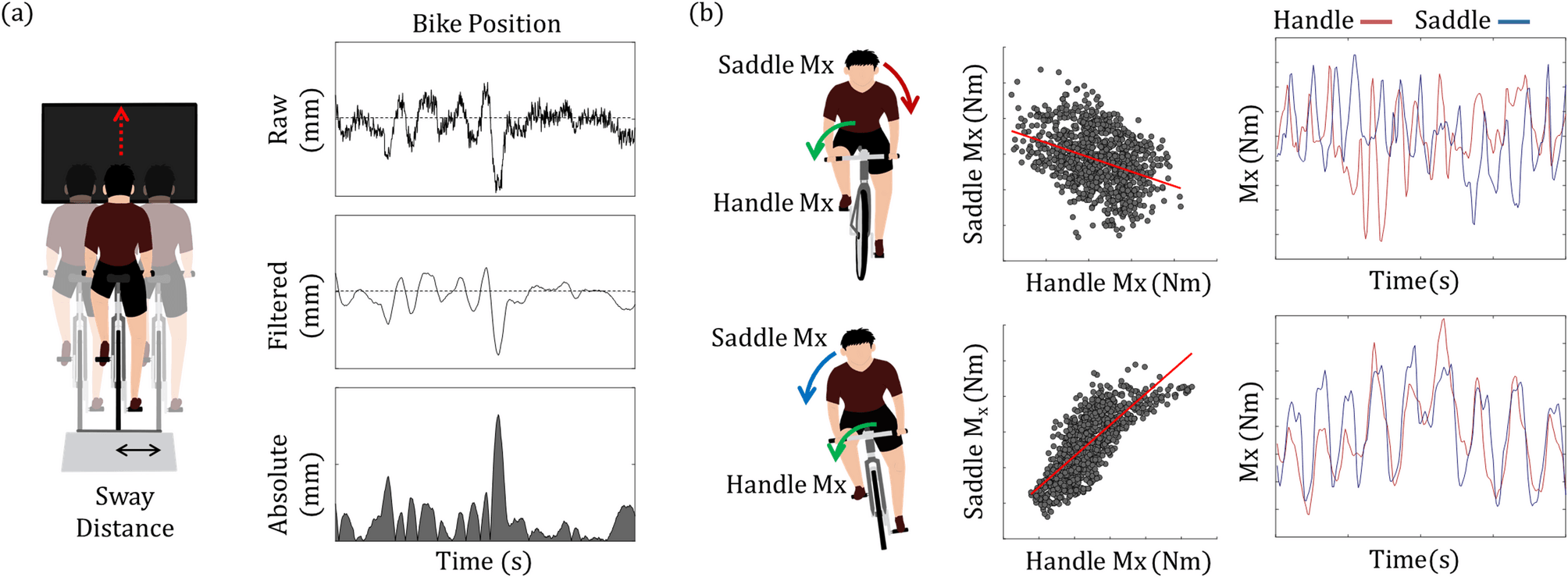
- Bicycle Sway Index: how far the bike drifted from the center line.
- Handle-Saddle Coordination Index: whether the forces at the handlebars and saddle moved together (riders leaning and steering as one unit) or in opposite directions (riders using steering to counter a lean).
- Sensor Fluctuation Index: how much the forces at the handlebars and saddle varied from moment to moment.
What they found
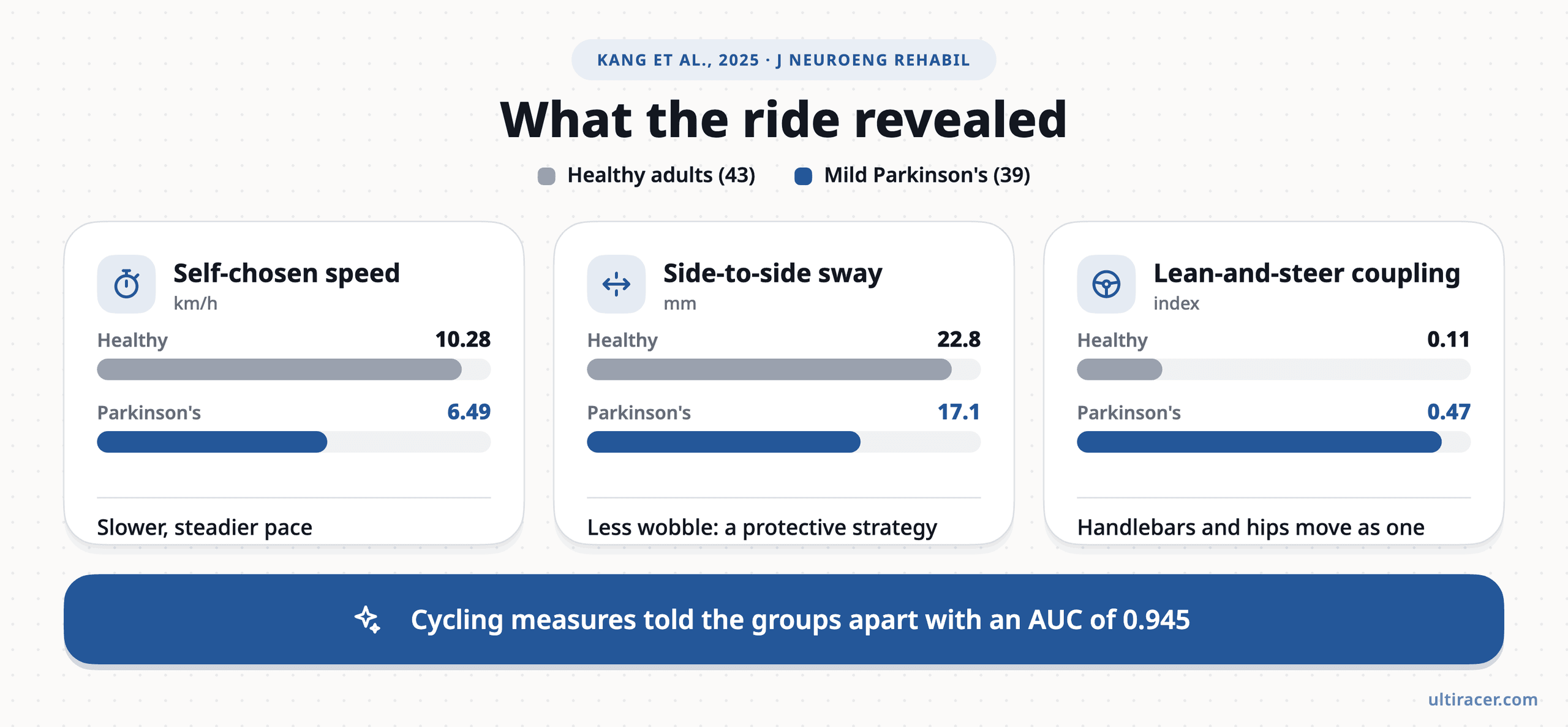
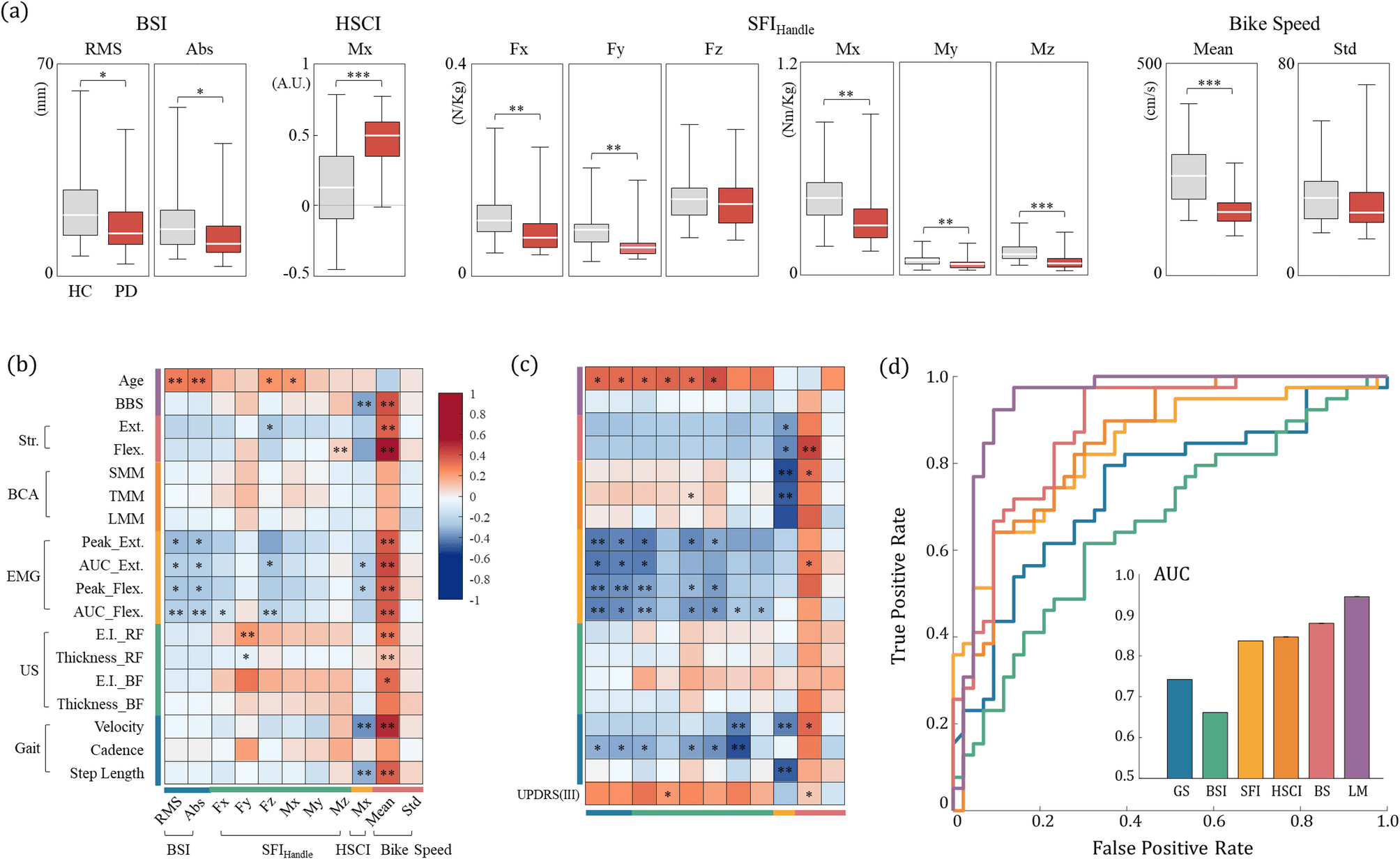
1. People with Parkinson's rode much slower. Their average self-chosen speed was 6.49 km/h, compared with 10.28 km/h for the healthy group.
2. They wobbled less, not more. The researchers expected more sway in the Parkinson's group. Instead, sway was lower: 17.1 mm versus 22.8 mm. The authors see this as a protective strategy, much like the slower, shorter steps people use when walking feels unstable.
3. They locked their upper and lower body together. The Handle-Saddle Coordination Index was 0.47 in the Parkinson's group versus 0.11 in the healthy group. In plain terms, riders with Parkinson's tended to push the handlebars and saddle in the same direction at the same time. Healthy older riders more often used the handlebars and their hips independently or against each other. Earlier research found the same coupled style in novice cyclists, while experts control steering and leaning separately (Cain et al., 2016).
4. The bike measures matched real-world walking. In the Parkinson's group, a stronger lean-and-steer coupling went with worse walking measures, even after adjusting for age, strength, symptom severity, balance score and body size. Interestingly, it did not track the standard Parkinson's motor score (UPDRS part III), which includes only 2 of its 18 items on balance and walking.
5. A short ride separated the groups well. Average bike speed on its own had an AUC of 0.880, higher than walking speed. A simple model combining speed, the coordination index, handlebar force fluctuation and sex reached an AUC of 0.945 and 91.4% accuracy (Kang et al., 2025). (AUC runs from 0.5, a coin flip, to 1.0, a perfect split.)
What it means for rehabilitation
This study focused on how people balance, not on building a diagnostic test, and it looked at people with mild Parkinson's riding in a straight line, so the findings still need to be confirmed with more varied groups and riding tasks. Still, the authors draw some practical conclusions:
- Cycling can train dynamic balance. Because people with Parkinson's adapt the way they ride to stay stable, a moving bike gives them a realistic, challenging balance workout.
- It could help guide the return to outdoor riding. Cycling measures might one day help clinicians judge when someone is steady enough to ride outdoors as part of their rehab.
- Training and assessment can happen together. For people who are not ready to ride outside yet, the authors describe the steerable indoor system as "a safe and dynamic rehabilitation tool" that lets them practice balance control while being objectively assessed.
These results fit with a companion study from the same team, which used AI to tell early Parkinson's apart from healthy aging using just 30 seconds of riding on the same platform. Read our breakdown: Can a 30-second bike ride flag early Parkinson's?
Bring dynamic balance training to your center
Ultiracer lets riders lean, sway and steer like they would outdoors, without the risk of falling, and measures balance and coordination with every ride. In research conducted by the Healing Care Empirical Support Team with ten older adults, participants rated Ultiracer's stability during exercise 4.6 out of 5 (Healing Care Empirical Support Team, 2023). If you work in neurology, physical therapy, senior care or wellness and want to explore Ultiracer for your patients or members, or discuss a research project, contact us and we will arrange a demo.
References
- Cain, S. M., Ashton-Miller, J. A., & Perkins, N. C. (2016). On the skill of balancing while riding a bicycle. PLOS ONE, 11(2), e0149340. https://doi.org/10.1371/journal.pone.0149340
- Healing Care Empirical Support Team. (2023). Demonstration of senior exercise capacity and function improvement using the balance training cycling system (Final report, Validation Test Support A-7). Gyeonggi Business & Science Accelerator; Industry-Academia Cooperation Office, Kyung Hee University.
- Kang, S., Park, J.-W., Kim, Y., Moon, J., Lee, Y., Lee, C.-N., Kim, J., Kim, S.-J., & Kim, B.-J. (2025). Biomechanical analysis of patients with mild Parkinson's disease during indoor cycling training. Journal of NeuroEngineering and Rehabilitation, 22, 127. https://doi.org/10.1186/s12984-025-01657-1
- Snijders, A. H., & Bloem, B. R. (2010). Cycling for freezing of gait. New England Journal of Medicine, 362, e46. https://doi.org/10.1056/NEJMicm0810287
- Snijders, A. H., Toni, I., Ružička, E., & Bloem, B. R. (2011). Bicycling breaks the ice for freezers of gait. Movement Disorders, 26(3), 367-371. https://doi.org/10.1002/mds.23530
- Tiihonen, M., Westner, B. U., Butz, M., & Dalal, S. S. (2021). Parkinson's disease patients benefit from bicycling: A systematic review and meta-analysis. npj Parkinson's Disease, 7, 86. https://doi.org/10.1038/s41531-021-00222-6