Can a 30-Second Bike Ride Flag Early Parkinson's? Inside the AI Study
By Shaun Cheon
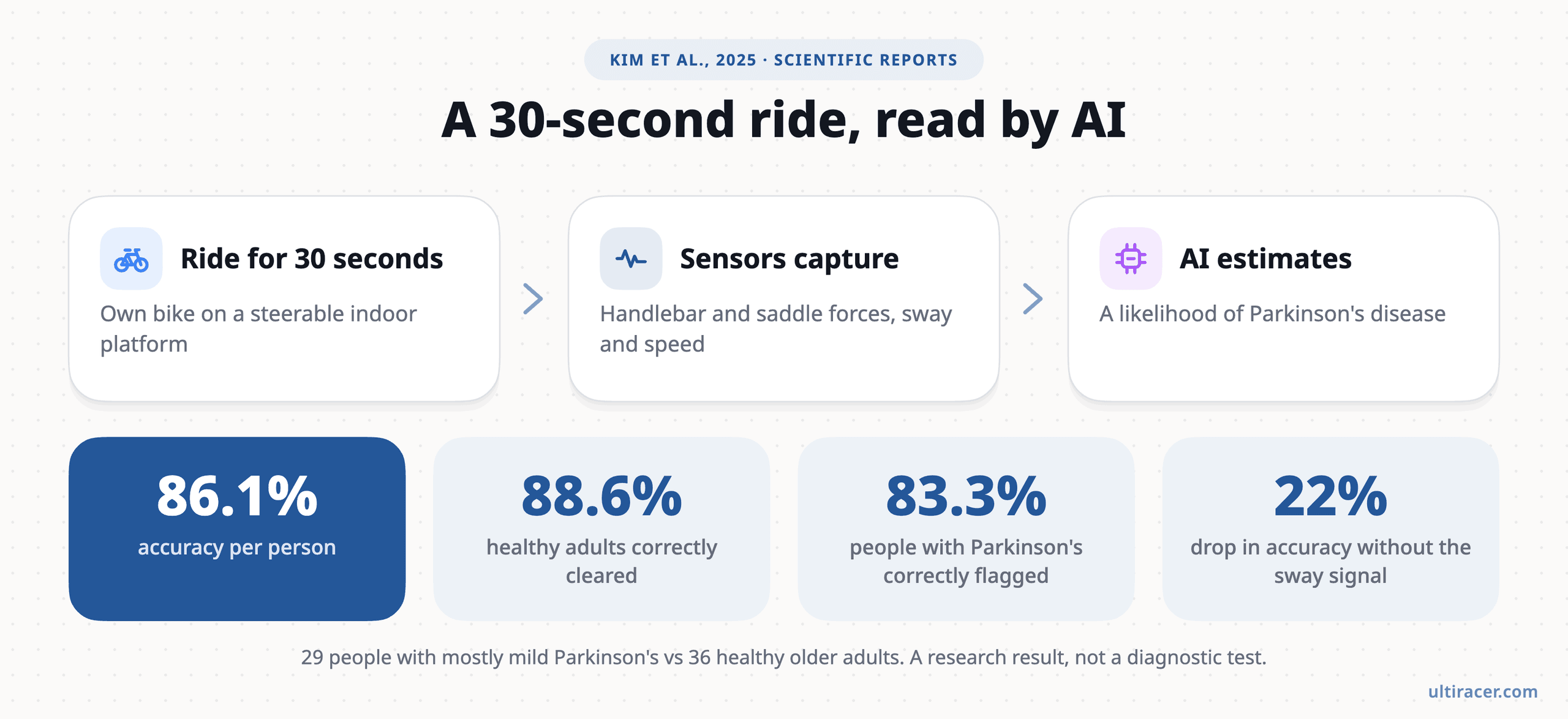
The short version: Researchers at Korea University College of Medicine asked a bold question: can a short ride on an indoor bike reveal early Parkinson's disease? They had 29 people with mostly mild Parkinson's and 36 healthy older adults ride their own bicycles on Ultiracer, a steerable indoor cycling platform, for three 30-second rounds while sensors in the handlebars and seat post recorded every push, lean and sway. A deep learning model trained on those rides told the two groups apart with 86.1% accuracy, with no sensors worn on the body and no calibration. The side-to-side wobble of the bike turned out to be the most telling signal of all (Kim et al., 2025). It is early research, not a diagnostic test, but it points to a future where the same ride that trains your balance could also keep an eye on it.
Why catching Parkinson's early is so hard
Parkinson's disease affects more than 9.4 million people worldwide and is a leading cause of disability (Kang et al., 2025). There is still no cure, but rehabilitation and medication can ease symptoms, which makes early detection and ongoing monitoring so valuable.
The problem is that early Parkinson's is easy to miss. Diagnosis still relies mostly on medical history and a clinical exam during scheduled visits, and the authors note that misdiagnosis rates in early Parkinson's have been reported at 15% to 24%. Brain imaging such as DaT-SPECT and FP-CIT PET/CT is far more reliable, but it is expensive and not available everywhere (Kim et al., 2025). Researchers have tried AI on MRI scans, EEG brain waves, handwriting, voice recordings and walking data. Each approach has trade-offs: scanners cost a lot, EEG needs an expert and electrode gel, and many methods need sensors strapped to the body.
The bicycle clue
Here is where cycling comes in. In 2010, neurologists in the Netherlands filmed a man with advanced Parkinson's whose walking froze after a few steps, yet who rode a bicycle smoothly (Snijders & Bloem, 2010). Researchers think the turning pedals act as a rhythmic cue, and that pedaling avoids the sideways weight shift you need to start each step (Snijders et al., 2011).
The Korea University team turned that idea around. If cycling uses movement control in its own special way, could the fine details of how someone rides carry a signature of Parkinson's? To find out, they needed a bike that does more than spin in place.
What the researchers did
Participants rode their own bicycles mounted on Ultiracer, made by RealDesignTech. Unlike a stationary bike, Ultiracer lets the bike move: the wheels sit on free-spinning rollers, and a pole under the frame slides side to side as the rider steers, much like riding outdoors, while keeping the bike upright so riders cannot fall.
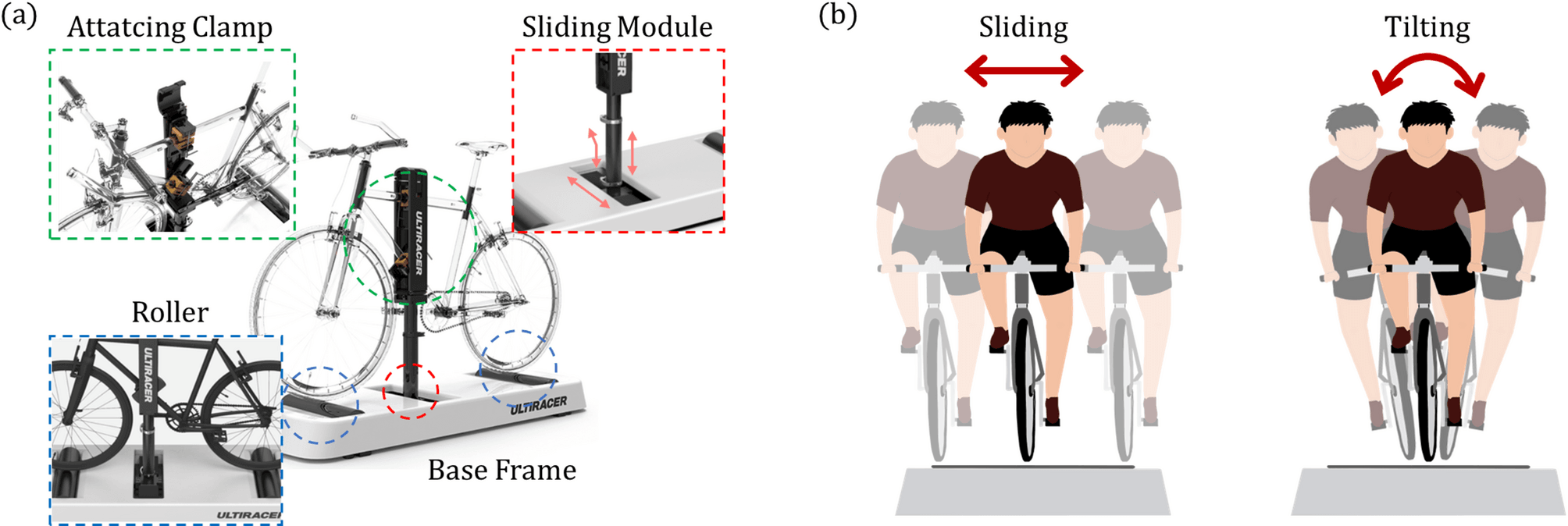
The setup recorded four kinds of data:
- Handlebar forces: a six-axis force sensor in the headset measured how riders pushed and twisted the bars.
- Saddle forces: a second sensor in the seat post captured how they shifted and leaned their weight.
- Side-to-side position: a laser sensor tracked how far the bike drifted from center.
- Speed: an encoder on the front roller measured how fast they pedaled.
The group included 29 people with Parkinson's (confirmed with FP-CIT PET/CT, most at early stage 1 or 2 on the Hoehn and Yahr scale) and 36 healthy older adults of similar age, height, weight and sex mix. After a short warm-up, each person did three 30-second rides at their own pace, trying to keep a marker centered on a game-style screen.
The team cut each ride into short two-second slices, about two pedal strokes each, and fed them to a one-dimensional convolutional neural network (CNN), a type of deep learning model that is good at spotting patterns in signals. The model also received each rider's age, sex, height and weight. Instead of a simple yes or no, it outputs a likelihood that a rider has Parkinson's.
What they found
- 86.1% accuracy per person. Across five rounds of cross-validation, the model correctly classified riders 86.1% of the time, with 83.3% sensitivity (people with Parkinson's correctly flagged) and 88.6% specificity (healthy adults correctly cleared).
- 80.7% accuracy per two-second slice. Even a single two-second snippet of riding carried a useful signal.
- Every sensor mattered. Removing any one input lowered accuracy by 13% to 28%.
- Sway was the star. Taking out the side-to-side position data caused the biggest drop, about 22% at the person level.
- The CNN beat newer AI designs. It outperformed LSTM and Transformer models on the same data.
Those results sit in the same range as many published approaches, from MRI-based AI (88.9%) to sensor-based gait analysis (83.7%), although different studies use different patients and methods, so the numbers are not a head-to-head race (Kim et al., 2025). The difference is how easy this test is to take: no scanner, no gel, no wearables, just a ride.
Why the wobble mattered most
Why would the bike's side-to-side movement be so revealing? The authors offer two ideas. First, the lateral position was the only signal shown to riders on screen, and people with Parkinson's are known to lean more heavily on visual information. Second, keeping a bike steady side to side uses the same kind of postural control that is affected even in early Parkinson's. Together, they suggest the wobble may capture subtle motor-control changes before obvious symptoms appear (Kim et al., 2025). It echoes what a companion study found when it looked at how people with Parkinson's balance on the same platform (Kang et al., 2025).
What it could mean for clinics, wellness centers and families
The study was small, most participants had mild Parkinson's, and the model still needs testing on new groups of people, so it is a promising first step rather than a finished screening tool. Anyone worried about symptoms should see a neurologist. But the direction is exciting:
- Assessment that feels like exercise. A 30-second ride is far less intimidating than a scan, and it can happen in a gym, rehab room or senior center.
- A likelihood, not just a label. A score that can be tracked over time is more useful for monitoring than a one-off yes or no.
- Training and tracking in one. Cycling has well-documented benefits for people with Parkinson's, including better motor function, balance and walking (Tiihonen et al., 2021). The authors see the same platform delivering rehabilitation and measuring progress at once.
This is the first of three studies we are unpacking in this series. Next week: what the same platform revealed about how people with Parkinson's keep their balance on a bike.
See it for yourself
Ultiracer brings the lean, sway and steering of a real ride indoors, keeps riders safe from falls, and measures balance and coordination as they go. In research conducted by the Healing Care Empirical Support Team with ten older adults, participants rated Ultiracer's stability during exercise 4.6 out of 5 (Healing Care Empirical Support Team, 2023). We call it Neurocycling. If you run a hospital, rehab clinic, research lab, wellness center or senior facility and want to explore what Ultiracer could do for your patients or members, get in touch with us to arrange a demo or talk about research collaborations.
References
- Healing Care Empirical Support Team. (2023). Demonstration of senior exercise capacity and function improvement using the balance training cycling system (Final report, Validation Test Support A-7). Gyeonggi Business & Science Accelerator; Industry-Academia Cooperation Office, Kyung Hee University.
- Kang, S., Park, J.-W., Kim, Y., Moon, J., Lee, Y., Lee, C.-N., Kim, J., Kim, S.-J., & Kim, B.-J. (2025). Biomechanical analysis of patients with mild Parkinson's disease during indoor cycling training. Journal of NeuroEngineering and Rehabilitation, 22, 127. https://doi.org/10.1186/s12984-025-01657-1
- Kim, Y., Kim, J., Kang, S., Lee, Y., Moon, J., Park, J.-W., Kim, B.-J., & Kim, S.-J. (2025). Convolutional neural networks-based early Parkinson's disease classification using cycling data from a steerable indoor bicycle. Scientific Reports, 15, 43253. https://doi.org/10.1038/s41598-025-27193-5
- Snijders, A. H., & Bloem, B. R. (2010). Cycling for freezing of gait. New England Journal of Medicine, 362, e46. https://doi.org/10.1056/NEJMicm0810287
- Snijders, A. H., Toni, I., Ružička, E., & Bloem, B. R. (2011). Bicycling breaks the ice for freezers of gait. Movement Disorders, 26(3), 367-371. https://doi.org/10.1002/mds.23530
- Tiihonen, M., Westner, B. U., Butz, M., & Dalal, S. S. (2021). Parkinson's disease patients benefit from bicycling: A systematic review and meta-analysis. npj Parkinson's Disease, 7, 86. https://doi.org/10.1038/s41531-021-00222-6