Ultiracer: The Indoor Cycling Platform That Feels More Real Than Zwift
By Shaun Cheon
"Once you've ridden it, you'll feel it's even more realistic than Zwift." That is how Joongsik Lee, CEO of RealDesignTech, describes the edge of his company's flagship product, the Ultiracer. In an interview with the Korean business outlet Maeil Business Newspaper (MK), Lee laid out why this indoor cycling platform - a CES 2020 Innovation Award winner - is reshaping what it means to ride a bike indoors.
The trouble with riding indoors
For years, cyclists who wanted to train indoors faced a set of imperfect options. A traditional stationary bike rarely matches the workout of riding on the open road. Mounting your own bike on a roller or trainer can deliver real intensity, but it raises safety concerns. And while fixed trainers exist, their fiddly setup has kept them from going mainstream. Every path involved a compromise - on realism, on safety, or on convenience.
A bike that sways but never falls
Ultiracer was built to remove those compromises in one stroke. You simply mount your own bicycle onto the platform and you are ready to ride. A component called the vertical support lets the bike lean and sway from side to side exactly as it would on the road, while making it impossible to tip over. When the MK reporter took it for a spin, the workout was on another level compared with a conventional stationary bike, and the ride reproduced the full range of motions you feel outdoors - pitching, rolling, yawing, and more. As Lee notes, even a professional spinning instructor is truly winded after about ten minutes; climb a virtual hill, and it feels just like a real one.
More realistic than Zwift - and compatible with it
The heart of Ultiracer's realism is how it handles movement. On screen-based platforms like Zwift, it is the map that scrolls rather than your avatar that truly moves, and riders' avatars can overlap because they cannot actually steer around one another. Ultiracer works differently. Using its own embedded sensors and multi-channel Bluetooth transmission, it converts the side-to-side kinetic energy of your ride into real positional data, so your avatar moves across the map on its own. Encounter another rider and you can turn your handlebars to steer around them - just like real life. "This left-right position tracking is the secret to a riding feel that's more lifelike than Zwift," Lee explains.
He is careful to set Ultiracer apart from the rest of the field. Unlike Zwift, which is essentially a content service, and unlike Peloton - often called the "Netflix of home fitness" - whose bike is not uniquely engineered, Ultiracer pairs truly original hardware with its own software. And in a sign of how open the platform is, Lee points out that Ultiracer runs on Zwift, too, giving riders the best of both worlds.
The accident that sparked Ultiracer
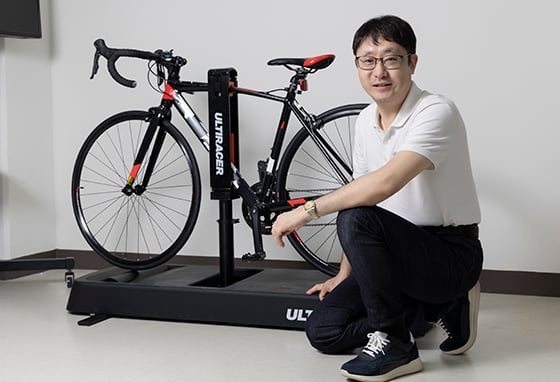
Ultiracer's origin is deeply personal. While preparing his graduate thesis, Lee gained a significant amount of weight, and a doctor warned him to slim down for his health. He took up cycling, loved it, and then narrowly survived a collision with a truck. He escaped with a relatively minor elbow injury, but the trauma made outdoor riding difficult afterward. His search for a way to ride realistically indoors became the seed of Ultiracer. What began as a personal project - simply building the bike he wished he could ride - grew into a company with the addition of a co-founder, a former Samsung Electronics senior researcher, who led the software side while Lee built the hardware.
From fitness gear to a mobility platform
Beyond delivering a realistic ride, Lee sees Ultiracer as something larger: a mobility platform that can plug into entirely new industries. Because it generates real positional data, it can move an avatar smoothly through a metaverse environment or act like a game controller - pedal to play. "Ultiracer's possible uses are wider than people expect," Lee says, and word of its capabilities has already drawn a wave of partnership proposals. (Korean gaming company Kakao Games, led by a cycling enthusiast, reportedly bought a unit for its own office.)
The bigger vision: senior healthcare and digital therapeutics

For all the excitement around gaming and the metaverse, the market Lee is most focused on is senior healthcare. As populations age worldwide, the opportunity is enormous: a report from the Korea Health Industry Development Institute put the global senior home-training market at around 124 trillion won. Indoor cycling, Lee argues, is one of the most effective forms of home training for older adults, and consistent riding may even help with mild cognitive impairment. His ultimate ambition is to develop Ultiracer into a digital therapeutic, drawing on research suggesting that pedaling stimulates both the muscles and the brain, improving balance and cognitive function. To turn that science into a real product, RealDesignTech is running a joint program with Korea University Medical Center to develop a digital treatment for patients with mild dementia, while also designing a version of Ultiracer optimized for seniors. The logic is compelling: people with dementia can rarely ride safely outdoors, yet Ultiracer offers a bike that never falls while delivering road-like exercise intensity.
For RealDesignTech, the journey from a personal workaround to a CES-recognized platform points to a bigger shift: indoor cycling is no longer just exercise equipment, but a gateway to healthier, more connected living. As the home fitness and senior healthcare markets keep growing, the company is optimistic that Ultiracer can sit at their intersection - bringing realistic riding to everyone from competitive cyclists to older adults, and one day standing alongside medicine as a tool for better cognitive health. "Better than a hundred explanations is a single ride," Lee says. "Get on, and you'll feel right away that this really is different."