Cycling to Work vs the Gym: What a 6-Month Trial Found for Insulin, Fitness and Belly Fat
By Shaun Cheon
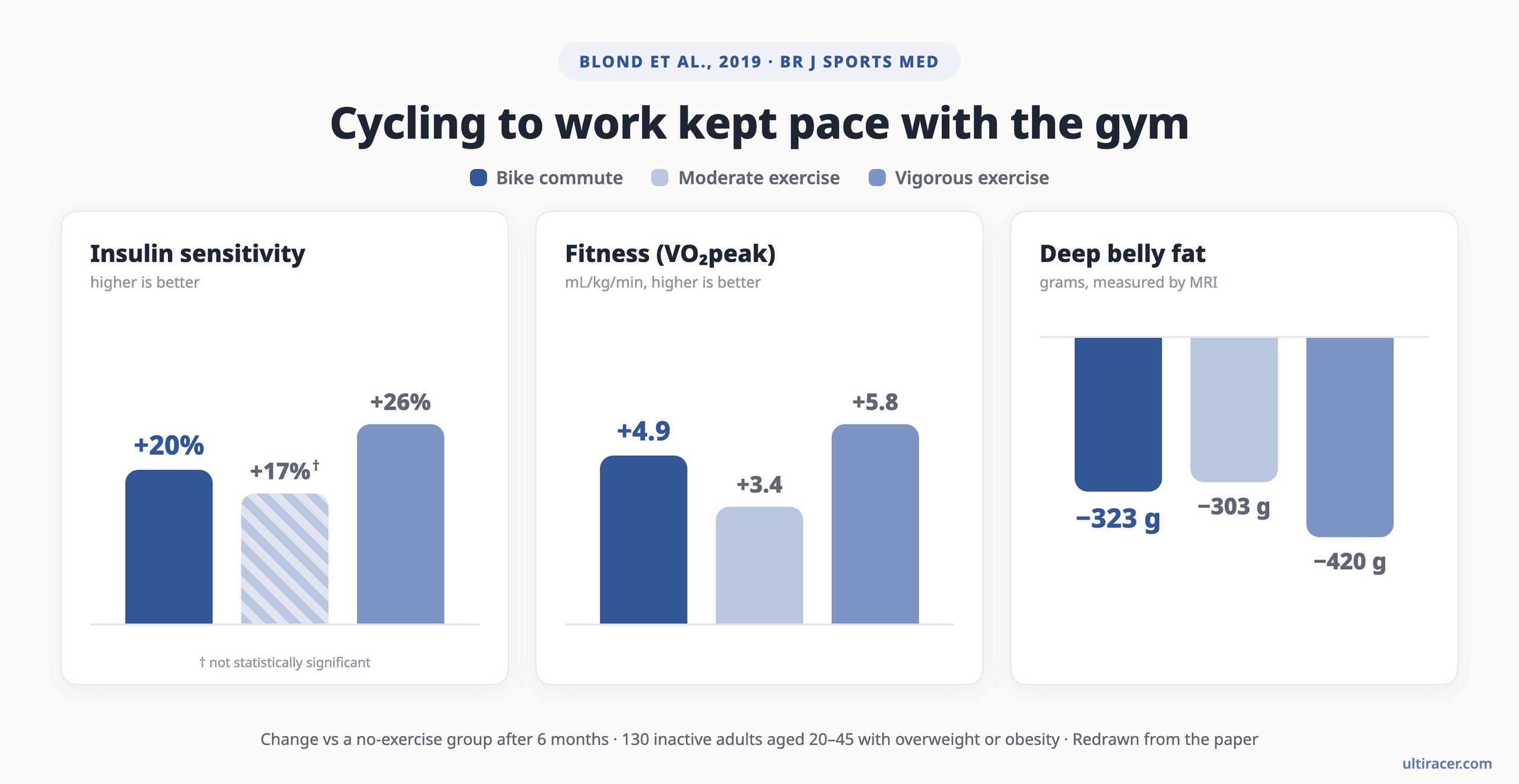
The short version: Can riding your bike to work do as much for your health as a gym routine? Researchers at the University of Copenhagen put that to the test in a six-month randomized trial with 130 inactive adults aged 20 to 45 who had overweight or obesity. People were assigned to cycle to work, to exercise in their free time at a moderate or vigorous pace, or to change nothing. Every exercise group was prescribed the same weekly energy expenditure. Bike commuters improved their insulin sensitivity by 20% compared with the no-exercise group, close to the 26% seen with vigorous leisure-time exercise. Compared with the no-exercise group, they also gained about 5 mL/kg/min in fitness and had around 320 g less deep belly fat, on par with the leisure-time exercise groups (Blond et al., 2019). The takeaway: the riding you fit into everyday life counts, as long as you keep doing it.
Why the trip to work matters
Lack of time is one of the most common reasons people give for not exercising. Active commuting gets around that by turning a trip you already make into exercise, and the World Health Organization encourages it as cities keep building bike lanes. Large observational studies link cycling to work with a lower risk of heart disease, cancer and early death (Celis-Morales et al., 2017), but they can't prove cause and effect.
The Copenhagen team wanted harder evidence. Their trial, called GO-ACTIWE, was the first randomized controlled trial to test whether commuting by bike improves insulin sensitivity, and whether it does as much for metabolic health as structured exercise (Blond et al., 2019).
Insulin sensitivity is how well your body responds to insulin, the hormone that moves sugar out of your blood and into your muscles. When it drops (insulin resistance), the risk of type 2 diabetes and heart disease goes up. Deep belly fat, the kind that wraps around your organs, is another warning sign.
How the trial worked
- Who: 130 physically inactive, otherwise healthy women and men aged 20 to 45, with a BMI of 25 to 35, living in the Copenhagen area.
- Four groups: cycle to and from work or school (bikes were provided if needed), leisure-time exercise at moderate intensity (about 50% of fitness reserve), leisure-time exercise at vigorous intensity (about 70%), or no change.
- The same dose: every exercise group trained five days a week and burned about 1,600 kcal a week for women and 2,100 kcal for men. Commuters followed a target daily distance set to match that energy cost.
- How long: six months, with tests at the start, three months and six months.
- What was measured: insulin sensitivity with the gold-standard clamp test, fitness (VO2peak) on an exercise bike, and deep belly fat with an MRI scan.
On an average exercise day, commuters rode for about 42 minutes at a moderate effort. The moderate group exercised for about 54 minutes and the vigorous group for about 37.
What they found
1. Commuting improved insulin sensitivity. At six months, insulin sensitivity was 20% higher in the bike commuters than in the no-exercise group and 26% higher in the vigorous group. The moderate group improved by 17%, just short of statistical significance. Only the vigorous group improved within the first three months.
2. Fitness rose in every exercise group. Compared with the no-exercise group, VO2peak was up by 4.9 mL/kg/min in commuters, 3.4 in the moderate group and 5.8 in the vigorous group, from a starting point of about 29. The authors note that every group gained more than 10% in fitness, a level linked in other research with a 15% to 20% lower risk of fatal cardiovascular disease.
3. Deep belly fat dropped by 15% to 20%. MRI scans showed 323 g less intra-abdominal fat in commuters, 303 g less in the moderate group and 420 g less in the vigorous group, compared with the no-exercise group. The differences between the exercise groups were not significant.
4. Weight and body fat came down too. Commuters lost 4.2 kg of fat mass and 3.7 kg of body weight compared with the no-exercise group, similar to the vigorous group (4.5 kg of fat). Waist size fell in the two leisure-time groups; the drop in commuters (2.9 cm) was not statistically significant.
Does intensity matter?
Somewhat. Vigorous exercise worked faster on insulin sensitivity and gave the biggest jump in fitness, and it was the only group that also lowered fasting insulin. Interestingly, commuters rode at a self-chosen pace of about 55% of their fitness reserve, a little harder than the moderate group, and gained about as much fitness as the vigorous group. The authors note one caveat here: fitness was tested on an exercise bike, which may have given the commuters a small advantage.
The authors are also clear about the limits. Copenhagen is one of the easiest cities in the world to cycle in, so the results may not carry over to other places. Some commuters had to take detours to hit their target distance. And 43% of the commuting group dropped out before the six-month test, more than any other group, which the authors suspect happened partly because many people were new to commuting by bike. They suggest that future research should focus on how to turn people into regular riders and help them stick with it.
When commuting by bike isn't an option
For many people, it isn't. Summer heat in the Gulf, icy winters, heavy traffic, long distances or simply feeling unsteady on a bike all get in the way. The study's lesson still applies: steady riding at a moderate effort, built into most days of the week, paid off. What matters is finding a way to ride that you will actually keep doing.
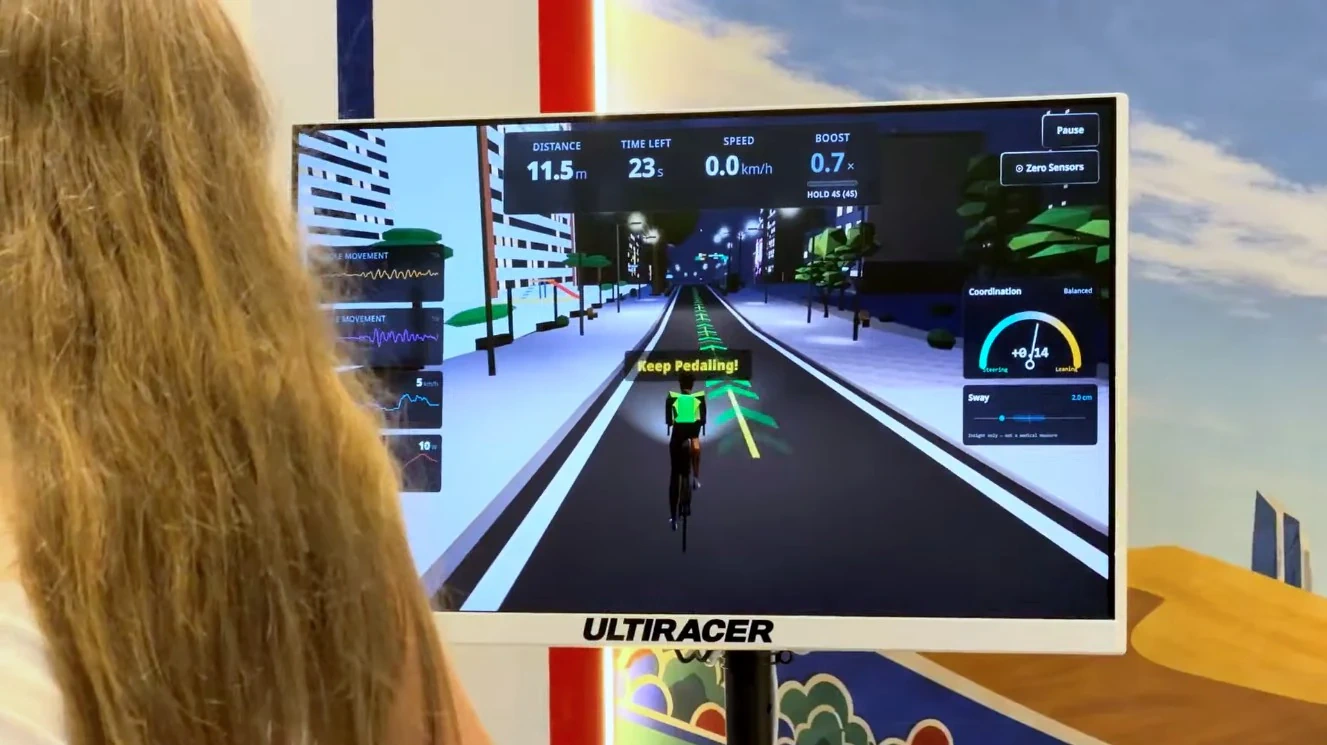
That is where an indoor ride can help, as long as it doesn't feel like a chore. Most stationary bikes keep the effort but lose everything that makes riding outdoors engaging. Ultiracer takes a different approach: your own bicycle sits on a platform that leans, sways and steers like a bike on the road, while you ride on-screen courses and race other riders. You get the aerobic workout of a real ride, plus balance and focus, with no traffic and no weather to worry about, on a platform designed to keep you from falling. We call it Neurocycling.
Ultiracer was not used in this trial, and we aren't claiming it produces these exact results. But the trial suggests that regular riding built into daily life can pay off, and Ultiracer is built to make that easier to keep up. Want to see the research done on Ultiracer itself? Start with our research series, from an AI that spotted early Parkinson's from a 30-second ride to a cardiac rehab pilot on an outdoor-style indoor bike. For why adding a game to a ride may help the brain too, read what the Cybercycle Study found.
Bring the ride indoors
Whether you run a gym, a corporate wellness program, a rehab clinic or a community center, Ultiracer gives your members a ride they will come back for, rain or shine. Get in touch with us to book a demo.
References
- Blond, M. B., Rosenkilde, M., Gram, A. S., Tindborg, M., Christensen, A. N., Quist, J. S., & Stallknecht, B. M. (2019). How does 6 months of active bike commuting or leisure-time exercise affect insulin sensitivity, cardiorespiratory fitness and intra-abdominal fat? A randomised controlled trial in individuals with overweight and obesity. British Journal of Sports Medicine, 53(18), 1183-1192. https://doi.org/10.1136/bjsports-2018-100036
- Celis-Morales, C. A., Lyall, D. M., Welsh, P., Anderson, J., Steell, L., Guo, Y., Maldonado, R., Mackay, D. F., Pell, J. P., Sattar, N., & Gill, J. M. R. (2017). Association between active commuting and incident cardiovascular disease, cancer, and mortality: Prospective cohort study. BMJ, 357, j1456. https://doi.org/10.1136/bmj.j1456