Same Workout, Sharper Brain: What the Cybercycle Study Found About Exergaming for Seniors
By Shaun Cheon
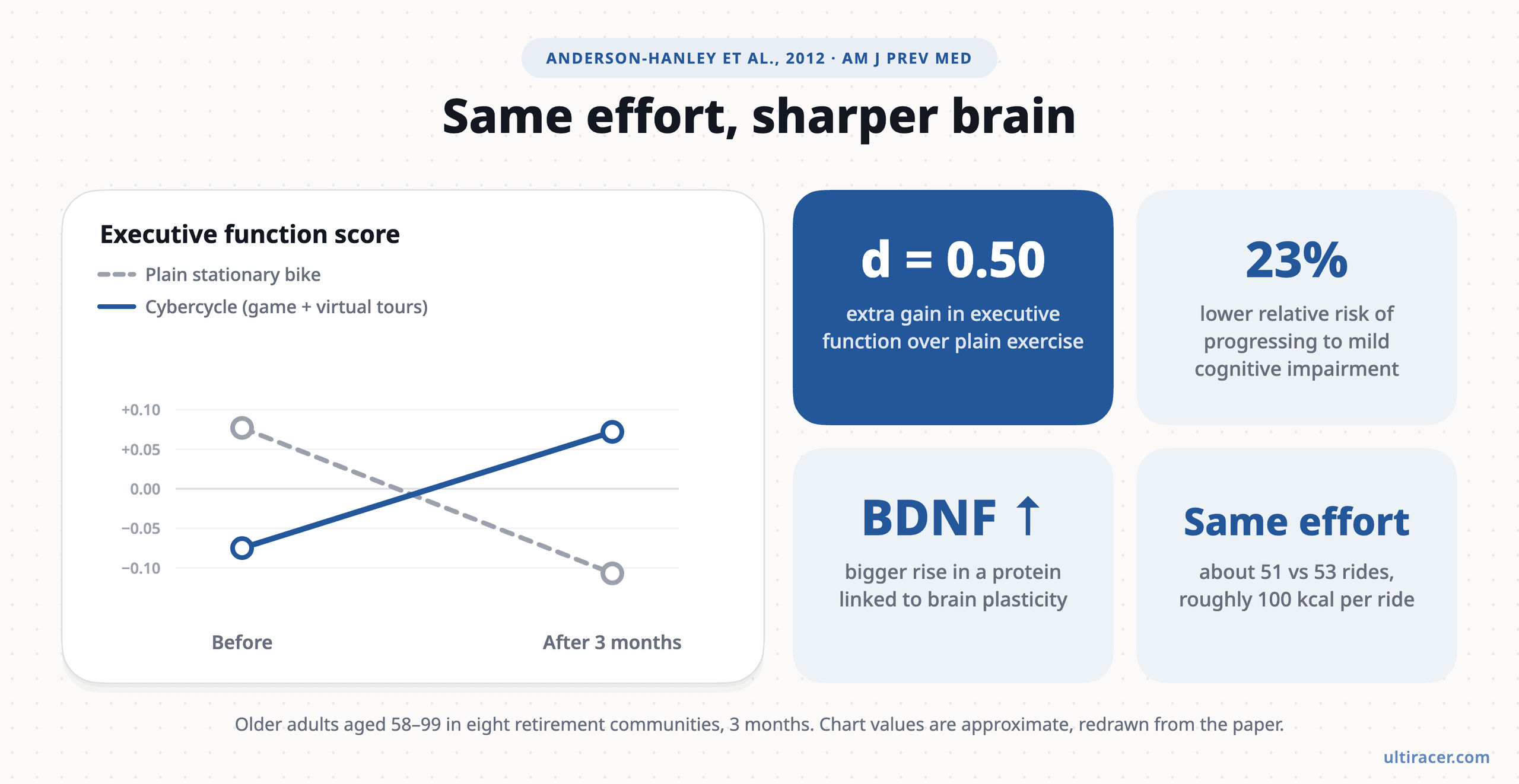
The short version: What if two people did exactly the same workout, but one came away with a sharper brain? That is what researchers found in the Cybercycle Study, a randomized trial run in eight retirement communities in New York. Older adults aged 58 to 99 rode identical stationary bikes for three months. Half rode a plain bike; the other half rode a "cybercycle" with interactive 3D tours and on-screen riders to race. Both groups put in the same effort, but the cybercyclists improved more in executive function (the planning and focus skills that keep us independent), were 23% less likely to progress to mild cognitive impairment, and showed a bigger rise in BDNF, a protein linked to brain plasticity (Anderson-Hanley et al., 2012). The lesson for anyone who cares about brain health: moving your body while your brain has decisions to make may give you more than either one alone.
Why "just exercise more" isn't enough
Dementia cases could reach 100 million worldwide by 2050, and exercise is one of the most promising ways to protect the aging brain. The catch is getting people to do it. The study's authors point out that only 14% of adults aged 65 to 74, and 7% of those over 75, reported exercising regularly, and that in one study fewer than 4% of patients followed their doctor's exercise prescription (Anderson-Hanley et al., 2012).
That is where exergaming comes in. Exergames combine physical exercise with video game features such as virtual scenery and competition, shifting attention away from the effort and toward something fun. The research team wanted to know whether that extra layer only makes exercise more appealing, or whether it actually does more for the brain.
How the Cybercycle Study worked
- Who: 102 older adults from eight independent-living retirement communities enrolled; 79 were randomized by site and 63 completed the trial. Ages ranged from 58 to 99.
- The bikes: everyone rode the same recumbent stationary bike, aiming for a moderate heart rate (about 60% of heart rate reserve) and working up to 45 minutes, five times a week, in line with exercise guidelines.
- Cybercycle group: after a month of getting used to the bike, riders pedaled through virtual 3D tours and raced a "ghost" of their own best ride. In the third month they were told to try to outpace the riders on screen.
- Traditional group: riders used the same bike without the virtual tours, seeing only their heart rate and distance. To give them equal attention, they joined monthly sessions on topics such as hydration and stretching.
- What was measured: executive function tests, clinical status (mild cognitive impairment), fitness and exercise effort, and blood levels of BDNF, before and after three months.
What they found
1. Sharper executive function. Executive function is the brain's "manager": planning, switching between tasks, staying focused and resisting distractions. The cybercycle group improved significantly more than the traditional group, with a medium effect size (d = 0.50) on top of what regular exercise achieved. Cybercyclists got faster on two timed tests (Color Trails and Stroop), while the traditional group did not change. On a memory-span test (repeating digits backward), cybercyclists held steady while the traditional group declined.
2. Fewer progressed to mild cognitive impairment. Over the study period, 9 riders in the traditional group and 3 cybercyclists progressed to mild cognitive impairment, a 23% lower relative risk for the cybercycle group.
3. A boost in a brain-growth protein. In the participants with blood samples, cybercyclists showed a greater increase in BDNF (brain-derived neurotrophic factor), a protein linked to the brain's ability to grow and rewire.
4. Same effort, different result. This is the surprising part. Both groups rode about as often (around 51 and 53 rides over the three months), for about as long, and burned about the same energy per ride, roughly 100 calories. Fitness changes were similar too. The extra brain benefit did not come from working harder.
One 86-year-old participant summed up the appeal: she felt healthier and credited it to trying to "compete with that fellow ahead of me!" (Anderson-Hanley et al., 2012).
Why a game made the difference
If effort was the same, what changed? The authors point to the mental side of the ride. Navigating a 3D landscape, anticipating turns and racing other riders demands focus, divided attention and quick decisions, the very skills that executive function tests measure.
They also compared their result with earlier research. Cognitive training alone has shown a negligible effect, physical exercise alone a small one (about 0.32), while combined physical and cognitive exercise in this trial produced a medium effect (0.50). That hints the two may work together, boosting the brain more than either does alone.
As with any single study, there are limits. The two groups differed in age and education at the start (the analyses adjusted for both), participants were highly educated, and the authors call for larger studies to confirm the findings. Still, it was the first randomized trial to compare virtual-reality-enhanced exercise with traditional exercise for older adults' cognition, and it suggests that adding interactive mental challenge to the same workout can bring extra benefit.
From cybercycle to Ultiracer
The authors closed with a suggestion that stuck with us. Future research, they wrote, could compare cybercycling with outdoor cycling, since real streets, obstacles, other cyclists and finding your way would add similar mental challenge, and could test those "outdoor" factors in controlled settings that keep riders safe.
That is the idea behind Ultiracer, which we built years later. Ultiracer was not used in this 2012 study, but it takes the same principle a step further: a real bicycle sits on a platform that leans, sways and steers like a bike on the road, while riders navigate on-screen courses and races with their own body. The ride combines aerobic effort, dynamic balance and cognitive challenge, which we call Neurocycling, and the platform keeps riders from falling. In research conducted by the Healing Care Empirical Support Team with ten older adults, participants rated Ultiracer's stability during exercise 4.6 out of 5 (Healing Care Empirical Support Team, 2023).
Researchers have since studied Ultiracer itself. Catch up on the series: an AI that told early Parkinson's apart from healthy aging using a 30-second ride, how people with Parkinson's keep their balance on a bike, and a cardiac rehab pilot on an outdoor-style indoor bike. For the bigger picture, see our roundup of the health benefits of cycling at every age.
Give your members a workout for body and brain
If you run a senior center, wellness center, hospital, rehab clinic or gym and want exercise your members look forward to, one that works their heart, balance and brain at the same time, get in touch with us. We will set up a demo and talk through how Ultiracer can fit into your programs.
References
- Anderson-Hanley, C., Arciero, P. J., Brickman, A. M., Nimon, J. P., Okuma, N., Westen, S. C., Merz, M. E., Pence, B. D., Woods, J. A., Kramer, A. F., & Zimmerman, E. A. (2012). Exergaming and older adult cognition: A cluster randomized clinical trial. American Journal of Preventive Medicine, 42(2), 109-119. https://doi.org/10.1016/j.amepre.2011.10.016
- Healing Care Empirical Support Team. (2023). Demonstration of senior exercise capacity and function improvement using the balance training cycling system (Final report, Validation Test Support A-7). Gyeonggi Business & Science Accelerator; Industry-Academia Cooperation Office, Kyung Hee University.